Indian Politics
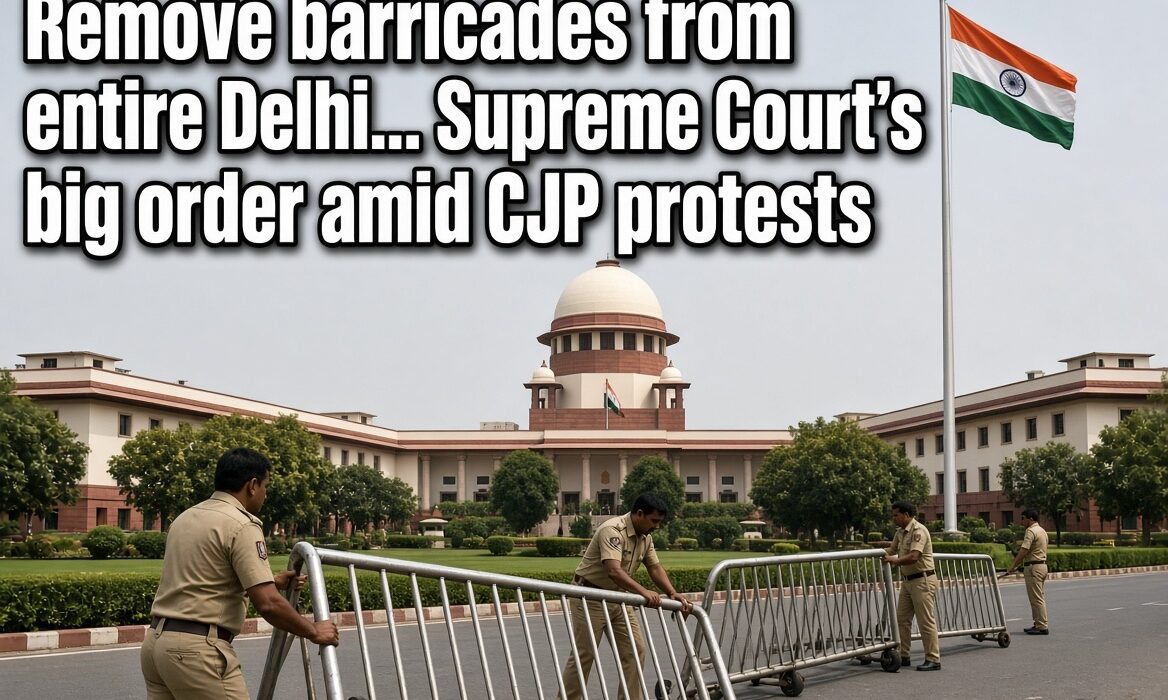
Supreme Court Orders Immediate Removal of Barricades Across Delhi, Restoration of Free Movement Amid CJP Protest Crackdown
New Delhi, October 11, 2026 — A special bench of the Supreme Court on Sunday directed the immediate removal of barricades across Delhi and the restoration of free movement of citizens, while ruling that internet services cannot be suspended, as it heard multiple petitions challenging police actions during the Cockroach Janta Party (CJP)-led protests on October 10.
The bench of Justice Joymalya Bagchi and Justice V. Mohana was hearing a clutch of pleas, including a contempt petition alleging violation of the court’s October 9 directions against a complete shutdown of metro and train services, as well as petitions raising concerns over large-scale detentions, alleged assaults on lawyers and journalists, and restrictions on public transport.
Background of the Protests
The Cockroach Janta Party, along with student groups and sections of the INDIA bloc, had called for a protest at Jantar Mantar on October 10 demanding the resignation of Chief Election Commissioner Gyanesh Kumar over alleged irregularities in the Special Intensive Revision (SIR) of electoral rolls. Delhi Police denied permission for the demonstration.
In anticipation, authorities imposed extensive security measures. Entry and exit points at dozens of Delhi Metro stations were closed (initially proposed for 57 stations, with around 45 ultimately affected), several trains were cancelled or regulated, multi-layered barricades sealed off central Delhi roads leading to Jantar Mantar, and internet services were suspended in parts of the city. Heavy deployment of police and paramilitary forces turned the designated protest site into a virtual fortress, forcing demonstrators into flash protests elsewhere in the capital.
Reports indicated that thousands of people — estimates ranging from around 3,000 to over 7,000 — were detained across the city. Those taken into custody included CJP leaders Abhijeet Dipke, Saurav Das and Ashutosh Ranka, YouTuber Dhruv Rathee, several opposition leaders including former chief ministers, lawyers, journalists, and ordinary citizens. Many detainees were later released, though some CJP leaders remained in custody for longer.
October 9 Order and Contempt Allegation
On October 9, a bench led by Chief Justice of India Surya Kant (along with Justices Joymalya Bagchi and V. Mohana) had already intervened, cautioning authorities against disproportionate restrictions. Invoking the principle of proportionality — famously remarking that one cannot “use a hammer to kill a fly” — the court directed that there should be no complete prohibition on the movement of metro trains or other railway services. It asked authorities to regulate rather than ban services, revisit road barricading, and widely publicise any restrictions and alternative routes so that ordinary commuters were not unduly inconvenienced.
A contempt petition filed by advocate Shailendra Mani Tripathi alleged that the subsequent closure of metro stations and continued restrictions violated this order. The petition named Union Home Secretary Govind Mohan, Delhi Police Commissioner Anurag Kumar, and DMRC Chairperson D. Thara among the respondents.
Sunday’s Hearing and Directions
During the special Sunday hearing, senior advocates including Kapil Sibal, Gopal Sankaranarayanan, Menaka Guruswamy, Shadan Farasat and others argued that the scale of restrictions and detentions violated fundamental rights under the Constitution. Guruswamy described the situation as effectively a habeas corpus matter for constitutional freedoms, drawing parallels with emergency-era curbs. Sankaranarayanan urged the court to order the immediate removal of all barricades across Delhi and full restoration of metro services without waiting for further notices.
Solicitor General Tushar Mehta, appearing for the Centre, informed the court that all metro stations had been reopened by 10 pm on Saturday and that services were operating normally. He stated that out of 303 metro stations, restrictions had been limited, with nearby stations remaining functional, and that thousands of train trips had run as per schedule. The government also confirmed that internet services had been restored.
The bench took the government’s assurance on record that metro services would continue normally, subject to any lawful public-order restrictions under Article 19(2). It directed the Delhi Metro Rail Corporation to submit a map detailing the stations where entries and exits had been closed and sought an assessment of the impact on commuters. The court ordered that barricades across the city be removed and free movement restored, while making it clear that internet services must not be shut down. It further emphasised that lawyers should not be obstructed in the discharge of their professional duties.
Justice Bagchi acknowledged the seriousness of the allegations of large-scale detentions and police action but stressed the need to protect the rights of all concerned — citizens, lawyers and the police — while urging all parties to maintain peace. The Centre was directed to file its responses to the various petitions by Tuesday. The court indicated that further orders could follow shortly.
Broader Context
The October 10 protest was the latest in a series of CJP mobilisations. The group had earlier organised demonstrations in July 2026 over competitive examination paper leaks, which also led to detentions and security measures in the capital. Sunday’s hearing underscored the Supreme Court’s continuing scrutiny of the balance between maintaining public order and safeguarding the rights of ordinary citizens and peaceful protesters.
The court’s directions on Sunday are expected to ease movement across Delhi as authorities implement the removal of barricades and continue normal public transport and internet services. Further hearings on the petitions, including the contempt plea and issues of detentions, are anticipated in the coming days.