Indian Politics
“There should be some proof” — Delhi Police’s answer to a journalist who says an ACP Vivek Bhagat grabbed her breast, while three women wait for an FIR that never comes.
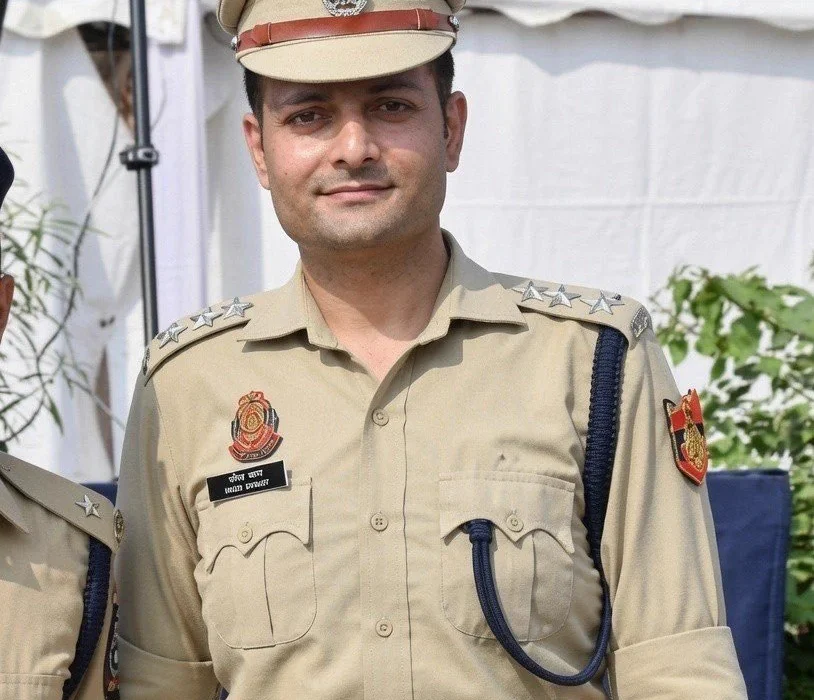
An independent woman journalist has accused Delhi Police Assistant Commissioner of Police Vivek Bhagat of grabbing her breast and shoving her while she was filming the detention of a protester at Jantar Mantar on 3 October 2026. Three women journalists have filed sexual-harassment complaints arising from the same police action. By Sunday afternoon the force had still not registered an FIR. The complaints have been moved to the Crime Branch, and a delegation that went into Parliament Street police station with the complainant was told the station would not open a case while that enquiry was on.
That is the record. It is an allegation, not a conviction. It is also the kind of allegation the law does not allow a police station to sit on.
What she says happened
The protest was against Chief Election Commissioner Gyanesh Kumar and the special intensive revision of electoral rolls. Police were detaining demonstrators, among them All India Students’ Association national president Neha Bora.
In a video circulated by Cockroach Janta Party founder Abhijeet Dipke, the journalist — named in several reports as Rosy, or Rosie — says she was recording Bora being put into a bus. She says she questioned Bhagat about women police personnel at the spot. She then says he squeezed her breasts and shoved her, and left when she raised an alarm. Other accounts of the same statement use “groped,” “hit her on the chest,” and “grabbed her breast.” The Tribune, which changed the complainant’s name, reported the same core claim and noted that it had not been independently verified.
She was taken to RML Hospital for a medical examination and then to Parliament Street police station. She said she sat there for more than three hours without an FIR. Journalists, lawyers and protesters gathered outside the station through the night demanding that one be registered.
Two other women journalists have also complained of sexual harassment by police personnel while covering the same operation. Delhi Police’s own post acknowledged all three.
What the police have done
Delhi Police said the New Delhi district had received the complaints and transferred them to the Crime Branch “for fair and impartial enquiry.” A district official had earlier told The Hindu that no case had been registered because there was no evidence to substantiate the allegation. On Sunday, Cockroach Janta Party said a delegation that included the complainant, Brinda Karat and Aishe Ghosh went inside the station and was refused an FIR on the ground that the Crime Branch enquiry was already under way.
That sequence is the problem. Outraging the modesty of a woman by assault or criminal force is a cognizable offence under Section 74 of the Bharatiya Nyaya Sanhita, punishable by one to five years. The Supreme Court’s rule in Lalita Kumari is that a cognizable offence disclosed in a complaint must be registered as an FIR. A preliminary enquiry is the exception, not the default, and it is not a licence for the same force to decide whether one of its own officers should be booked. Transferring a file to the Crime Branch can keep the enquiry off the accused officer’s own district. It is not a substitute for registration.
Police have also cited prohibitory orders under Section 163 of the Bharatiya Nagarik Suraksha Sanhita and warned the gathering outside Parliament Street that those who did not disperse could be detained. The people asking for a case were treated as the law-and-order issue. The officer named in the complaint was not.
Bhagat, reported as the officer responsible for the Connaught Place circle and as a 2017 civil-services batch officer, has not issued a public reply in the coverage so far. Claims by campaigners that he has faced similar complaints before have not been independently established.
Why the delay matters
A woman covering a detention says a uniformed ACP used his hands on her body and then pushed her out of the way. She has a video statement, a hospital examination, and hours spent at a police station. If the footage from Jantar Mantar and nearby cameras supports her, the case is straightforward. If it does not, an FIR still does not convict anyone. It starts the process in which statements are recorded, footage is seized, and the officer gets to answer.
Refusing that step protects the institution, not the enquiry. Sexual-harassment complaints against police already fail at the door more often than they fail in court, because the first decision is made by colleagues of the accused. Here the refusal was public. Leader of the Opposition Rahul Gandhi asked why the force had not done the basic duty of registering a complaint, and addressed the question to Home Minister Amit Shah, under whose ministry Delhi Police sits. Priyanka Gandhi Vadra said the force meant to provide security was making women feel threatened. The Press Council of India has asked Delhi Police to act. None of that is a finding of guilt. All of it is a finding that the station did not do what the law requires when a cognizable complaint is made.
Journalists are not a protected class. In a protest they are the people most likely to stand between a detention and a public record. If an officer can put a hand on a woman who is filming, and the system’s first response is to ask for “some proof” before it will even write an FIR, the next reporter will think twice before raising a camera. That is the point of this case, whether or not Bhagat is eventually charged.
The Crime Branch should seize the video, the hospital record, and every camera that faced that bus. It should record the three complainants under the sections they have invoked, not under an internal note. And it should do it in the open. An enquiry that begins by refusing the FIR is already choosing a side.