📰
Indian Politics
Badge-less police personnel spotted again near Jantar Mantar as forces tighten cordon around Election Commission of
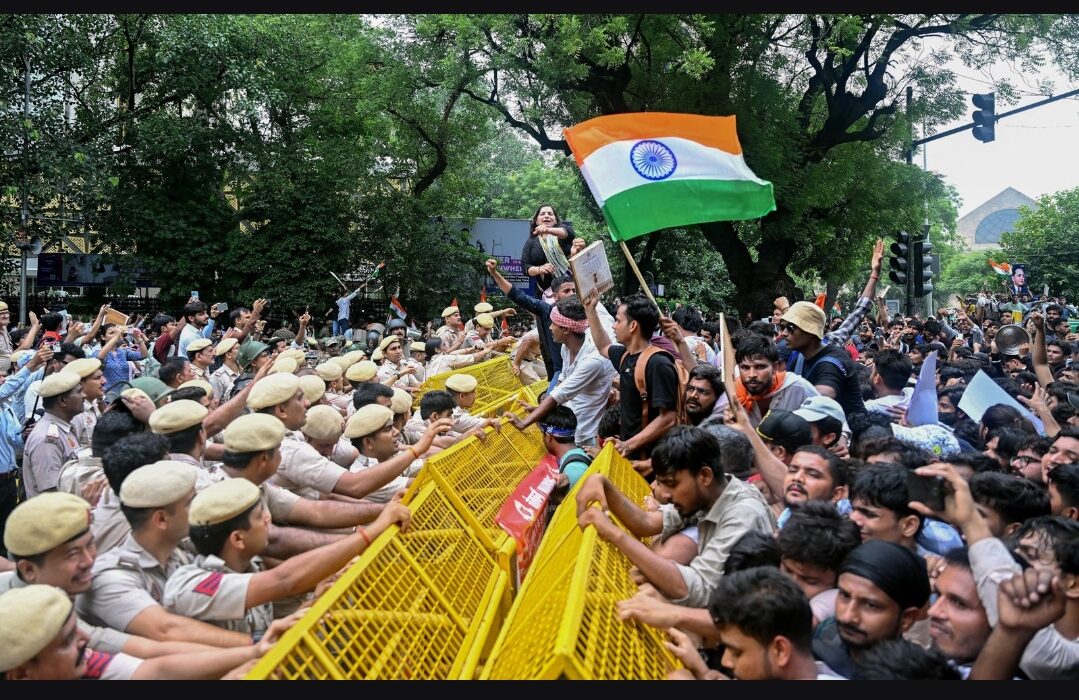
New Delhi, September 26, 2026 — Delhi Police have cordoned off Jantar Mantar and deployed additional personnel outside the Election Commission of India (ECI) office amid protests over the Special Intensive Revision (SIR) of electoral rolls and demands for Chief Election Commissioner Gyanesh Kumar’s resignation. Questions have again been raised about police officials without visible name tags — commonly called “batches” or name plates — at the protest site.
The deployment comes a day after police detained several activists, students and at least two journalists during a demonstration on Friday. Those taken away included CPI(ML) Liberation general secretary Dipankar Bhattacharya, activist Yogendra Yadav, AISA national president Neha Bora, transparency campaigner Anjali Bhardwaj, and The Wire correspondent Mohammad Irfan. Police later transported groups of detainees to stations in outer Delhi.
A senior officer said the gathering had no prior permission. “No application was submitted and no permission was obtained. They are being removed,” the officer told PTI. Section 189 of the Bharatiya Nyaya Sanhita, which restricts assemblies of more than five people, is already in force in the Jantar Mantar area. Extra cameras have been installed and more forces, including Rapid Action Force and BSF units in some reports, have been mobilised around the ECI office on Ashoka Road.
Indian Youth Congress workers also marched from Raisina Road toward Jantar Mantar on Friday, wearing masks of Kumar’s face. Delhi Congress has announced further protest action. The Cockroach Janta Party (CJP), which led large protests at the same site in July, has threatened “Jantar Mantar 2.0” if the CEC does not resign.
The missing name-tag question returns
Protesters and journalists covering Friday’s events again pointed to personnel without name plates. One reporter told Newslaundry that a Delhi Police official who shoved him away from the site was not wearing a name tag and refused to give his name or badge number when asked. Similar complaints were made in July during the CJP-led protests over the NEET paper-leak controversy.
In July, videos showed both uniformed personnel without name plates and men in civilian clothes carrying lathis. Delhi Police later issued directions that officers at Jantar Mantar must report in uniform with name plates. Special Commissioner Anil Chaudhary had said every officer had been briefed that name plates were mandatory, adding that plates sometimes break or fall off. The same issue has now resurfaced at a smaller but politically charged gathering targeting the poll panel.
Legal experts have long cited the Supreme Court’s DK Basu guidelines and Section 36 of the Bharatiya Nagarik Suraksha Sanhita, which require police officers making arrests or using force to display “accurate, visible and clear identification.” Retired judges and former police officers have described a combination of missing name tags and plain-clothes personnel during crowd-control operations as problematic for accountability.
Police have maintained that force is used only after warnings and that the current restrictions are needed because the protest is unauthorised. They have not issued a fresh public statement specifically addressing name-tag compliance on Friday.
Why the site matters
Jantar Mantar remains Delhi’s designated protest zone, a short distance from Nirvachan Sadan. Heavy yellow barricades, multi-layered police lines and additional surveillance have become a recurring feature whenever large or politically sensitive demonstrations are expected. The SIR exercise — and an Indian Express report that two Election Commissioners had recorded objections to several related decisions — has turned the poll panel into the latest target after the July student agitation that ended with the resignation of the then Education Minister.
Opposition parties are also discussing possible parliamentary action against the CEC. For now, the immediate picture at Jantar Mantar is familiar: barricades, extra cameras, detained protesters, and renewed questions about whether every officer on duty can be identified.
The police say they are prepared for a larger turnout if CJP or other groups convert the 48-hour ultimatum into a bigger mobilisation. Whether name plates stay on this time will be one of the first things observers will check.