Indian Politics
The “Dhritarashtra” Parallel: Analyzing Sharad Pawar’s Political Tightrope Amid the Delimitation Debate
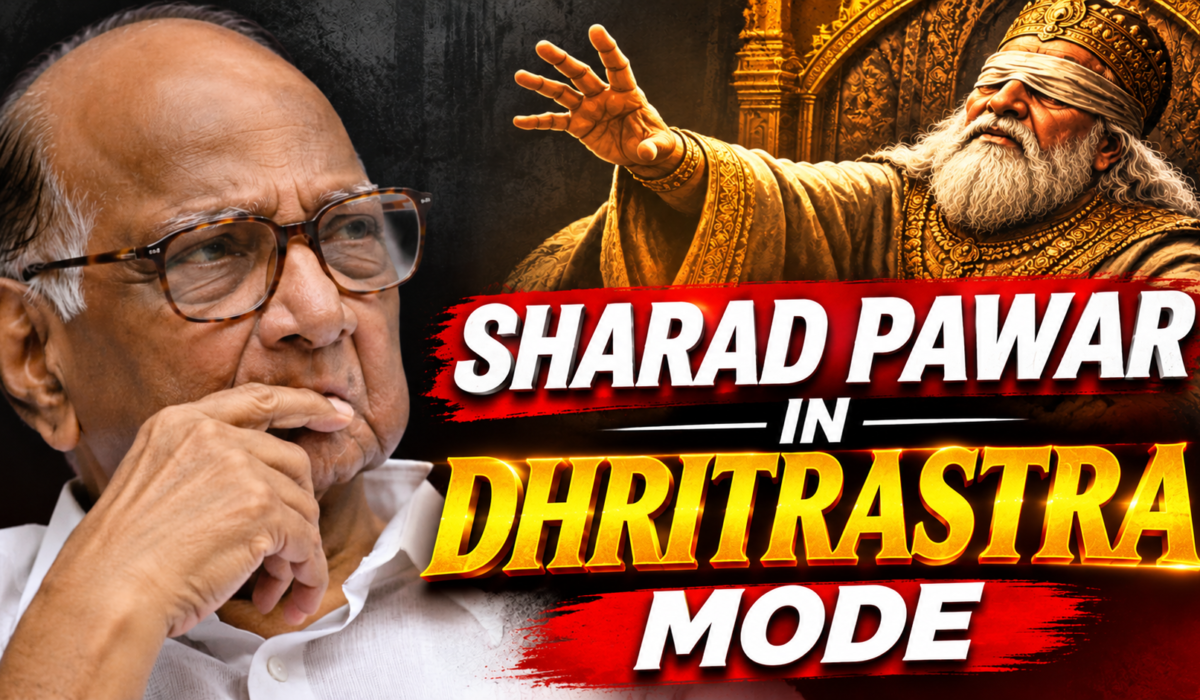
In Indian political commentary, the Mahabharata metaphor of Dhritarashtra—a patriarch whose strategic vision is perceived by critics as clouded by familial affection and succession anxiety—is occasionally invoked to critique veteran leaders.
In Indian political commentary, the Mahabharata metaphor of Dhritarashtra—a patriarch whose strategic vision is perceived by critics as clouded by familial affection and succession anxiety—is occasionally invoked to critique veteran leaders. Following the Nationalist Congress Party (Sharadchandra Pawar)’s recent signals regarding the Centre’s proposed Delimitation Bill, commentators on platforms such as The News Launcher and several opposition leaders have revived this exact critique, arguing that Sharad Pawar’s political calculus is increasingly driven by securing the future of his daughter, Supriya Sule, even at the cost of alliance cohesion.
However, examining Pawar’s decades-long political playbook alongside recent developments in Maharashtra offers two sharply contrasting interpretations: one of self-interested political survival, and another of calculated pragmatism designed to keep his party relevant in a shifting landscape.
The Critique: Familial Succession Over Alliance Loyalty
Critics within the Maha Vikas Aghadi (MVA) and political commentators—including panelists on The News Launcher—argue that Pawar’s recent posture on the Delimitation Bill resembles a patriarch prioritizing his heir’s political security over collective ideological commitments.
- The Delimitation Pivot: Ahead of the special parliamentary sitting scheduled for November 30, 2026, NCP (SP) leader Jitendra Awhad stated after meeting Pawar that the party would support the delimitation process as a “constitutional requirement.” Prior to this, Supriya Sule had remarked that it would be premature to reject the legislation without reading its provisions, noting that parties should not oppose bills merely because they are brought by the government.
- Backlash from MVA Partners: These signals triggered sharp reactions from alliance partners. According to India Today and The Times of India, the Maharashtra Congress publicly reminded Pawar and Sule that in March 2026, despite the NCP (SP) having only 10 MLAs against the required 36 votes, the Congress (16 MLAs) and Shiv Sena (UBT) (20 MLAs) had set aside their own claims to ensure Pawar’s unanimous election to the Rajya Sabha.
- Accusations of Opportunism: Shiv Sena (UBT) leader Sanjay Raut noted that the party’s eight Lok Sabha MPs won with MVA backing rather than BJP support, warning that unilateral decisions would alienate voters. Similarly, Congress leader Vijay Wadettiwar accused the NCP of lacking ideology and being unable to survive without power, prompting the NCP (SP) to skip a key opposition strategy meeting and demand an apology. Commentators critical of Pawar frame this sequence as a “Dhritarashtra moment”—suggesting that the veteran leader is willing to compromise hard-won opposition unity to ensure a safe political landing or ministerial prospects for Sule.
The Counter-Perspective: Classic “Pawar-Play” and Strategic Survival
Political analysts and observers familiar with Pawar’s five-decade career view these moves less as emotional blindness and more as a continuation of his long-standing doctrine of strategic ambiguity.
- “Keeping Opponents Guessing”: As noted by The Indian Express, Pawar’s political career has consistently involved maintaining open channels with rivals while negotiating with allies. In his own memoir, Pawar described his approach as moving “four steps ahead” while opponents are still trying to decipher his intentions, especially when operating from a position of numerical weakness.
- Navigating Institutional Pressure: Former Maharashtra Chief Minister Prithviraj Chavan suggested that the NCP (SP)’s softer stance on the Delimitation Bill might stem from pressure faced by its eight Lok Sabha MPs rather than a straightforward ideological shift. With the party’s legislative footprint significantly reduced following the 2023 split and subsequent elections, Pawar faces the challenge of preventing further defections among restive MPs and MLAs.
- Constitutional Framing: Supporters and party functionaries emphasize that delimitation—which proposes expanding the Lok Sabha to 850 seats—is a major structural exercise affecting Maharashtra’s future representation. From this viewpoint, engaging with the legislative process rather than staging an outright boycott allows the party to negotiate on state-specific interests while retaining leverage with both the ruling dispensation and the opposition.
A Legacy at a Crossroads
At 85, Sharad Pawar occupies a complex space in Indian politics. To his detractors, the divergence between the NCP (SP) and the broader INDIA bloc over a critical constitutional bill reinforces the narrative of a leader prioritizing dynastic continuity and personal survival—the classic critique associated with the Dhritarashtra analogy. To his defenders, it is simply the latest chapter in the career of a consummate survivor who refuses to be boxed into predictable alliances, keeping every political door ajar until the final numbers are counted.