Indian Politics
No Crime , No Weapon, Still Beaten: How Delhi Police Manhandled Innocent Citizens at Jantar Mantar
Jantar Mantar was meant to be the place where dissent in the capital could still be heard. Over the past three months it has looked more like a site the state prefers to empty before anyone speaks.
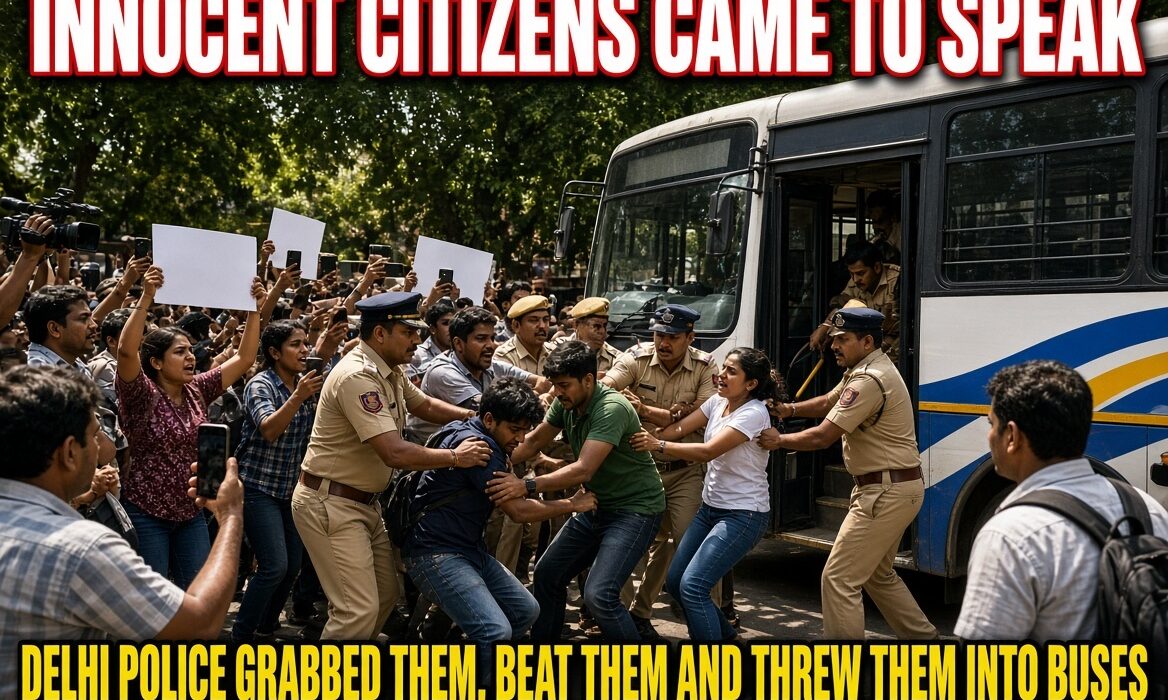
- Innocent Citizens Came to Speak. Delhi Police Grabbed Them, Beat Them and Threw Them Into Buses.
The question is no longer whether Delhi Police may regulate a protest next to Parliament. It is whether regulation has become a standing substitute for force, and whether force, when it is used, is being examined as seriously as the slogans that provoke it.
A designated site that is hard to reach
In 2018 the Supreme Court held that protests at Jantar Mantar could not be banned outright, and asked the authorities to balance the right to assemble with the inconvenience caused to residents. Delhi Police standing orders then capped gatherings, required advance permission, and treated the stretch as a managed venue rather than an open street.
That compromise has thinned. Permission is often sought ten days ahead, with lists of volunteers and speakers. Prohibitory orders under Section 163 of the Bharatiya Nagarik Suraksha Sanhita are frequently already in force in New Delhi district, so an assembly of five or more can be treated as unlawful before it forms. On 18 September 2026 the Delhi High Court asked, of a refused permission, how a blanket ban could be justified merely because the police feared the crowd might grow. The question has not been answered in practice. Activists now describe the approach roads as a police cantonment: barricades on Tolstoy Marg, Janpath and Ashoka Road, searches at the last turn, and buses waiting before the first slogan.
A right that exists only inside a permission the police may withhold is a right in name.
20 July: force after a march the police had not allowed
The sharpest recent test came on 20 July 2026. The Cockroach Janata Party, with activist Sonam Wangchuk on hunger strike over the NEET-UG leak and demands for the resignation of the then education minister, had permission for a sit-in, not a march on Parliament. Thousands gathered. When sections of the crowd pushed past barricades toward Sansad Marg, Delhi Police and the Rapid Action Force used lathis, water cannons and tear gas. An entry in the Parliament Street police station’s daily diary, reported by the Hindustan Times, recorded the use of anti-riot guns and plastic pellets by RAF personnel. The police have not officially confirmed pellet firing. A Frontline account alleged more than a hundred hospitalisations, including fractures and head injuries, and claimed some batons had nails driven into them. Those claims are contested and unadjudicated.
The police case is not empty. Officers say warnings were given, that the march was unauthorised in a high-security zone, and that stones were thrown and vehicles damaged. PTI reported injuries on both sides. Additional Solicitor General S.V. Raju later told the Delhi High Court that footage showed stone-pelting. An initial police post on X, denying that any violence or detentions had occurred and calling the handling “professional,” did not survive the day’s own visuals. The force later described the lathi charge as a last resort.
Last resort is a legal standard, not a press line. Under Indian law, force must be necessary, proportionate, and directed at those who are actually resisting. Tear gas fired into a packed lane, batons used on people already turning away, and the absence of name tags on many RAF personnel fail that test even if some in the crowd had breached a barricade. A widely circulated clip appeared to show Additional DCP Sandeep Lamba slapping a woman protester. Women told reporters they had been manhandled. The Delhi High Court, on 22 July, issued notice on petitions alleging excesses and ordered preservation of CCTV and other records. The Supreme Court has since set up a five-member enquiry headed by former judge Justice R. Subhash Reddy. Until that enquiry reports, the gravest allegations — pellets, nailed lathis, sexualised use of the baton — should be treated as allegations. They should not be treated as rumours the police are free to wave away.
Wangchuk was removed from the site and taken to hospital. Internet services in parts of central Delhi were cut. Cutting the network does not disperse a crowd. It disperses the record.
2 October: detention as the method
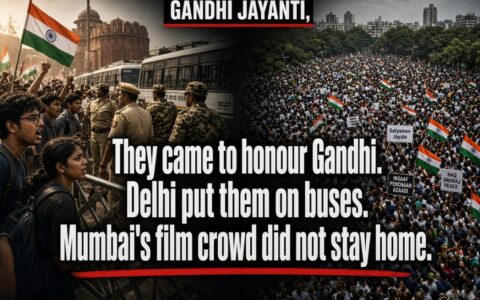
The 2 October protests against Chief Election Commissioner Gyanesh Kumar, over the Special Intensive Revision of electoral rolls, were handled differently and, in some ways, more revealingly. Permission was refused. More than 4,000 personnel were deployed. Drones watched the approaches. People arriving from Ashoka Road, Janpath and Tolstoy Marg were stopped, lifted, and put on buses for Fatehpur Beri, Badarpur and other stations. Police figures settled near 550; other counts, including NDTV’s, put detentions near 1,000. Among those taken were former chief minister Atishi, AAP leaders Saurabh Bharadwaj and Sanjay Singh, RJD MP Manoj Jha, and student and civil-society figures including Neha Bora and Yogendra Yadav. Most were released later. Three FIRs were registered under Section 223 of the Bharatiya Nyaya Sanhita for disobedience of a promulgated order.
There was no repeat of the July tear-gas barrage. That is not the same as restraint. Preventive detention of people who have not yet assembled, including elected representatives, converts the offence of “disobeying an order” into a reason to clear the street before a meeting can occur. Atishi called the handling barbaric. A Miranda House student showed reporters bruises she said came from being dragged. Police said gatherings were videographed and that minor scuffles occurred. Videography is useful only if it is produced when a complaint is filed, not retained as an internal file.
The Election Commission has rejected the allegations that brought people to the site. That dispute is separate from the method used to stop them speaking.
What “atrocity” does and does not cover
Atrocity is a heavy word, and it should not be spent on every inconvenience of a barricade. Police near Parliament have a real duty. A march that dismantles cordons in a zone that has seen attacks cannot be waved through because the cause is popular. Some of the July injuries to officers were real.
The pattern that deserves the harder question is narrower.
First, permission is used as a veto. The High Court has already doubted refusals based on apprehension alone. If every large political protest can be denied because it might exceed a cap, Jantar Mantar is no longer a designated site. It is a site designated to be empty.
Second, the threshold for force is opaque. Name tags missing, an early denial that anything had happened, and a later claim of last resort are not a chain of accountability. Pellet guns, if fired, are a weapon associated with lasting injury. Their use on students in the capital, if the diary entry is accurate, needs a public explanation of who ordered it and why lesser measures had failed.
Third, women and the young are absorbing blows that the official statement does not describe. A slap on camera is not crowd control. Dragging a person into a bus for the act of walking toward a permitted venue is not a minor administrative step.
Fourth, enquiry is slow relative to repetition. July is before a court and a Supreme Court committee. October produced a fresh round of detentions and FIRs against the protesters, not against any officer. The incentive runs one way.
Article 19(1)(a) and (b) are not absolute. They are also not permissions. The state’s answer — security, resident inconvenience, the risk of a march on Sansad Marg — explains why a cordon may exist. It does not explain nailed batons if they were used, a slapped protester, a denied march that became a baton charge, or a sealed square in which the only available assembly is the inside of a police bus.
Jantar Mantar was the compromise the Court offered so that dissent would not have to choose between silence and a confrontation at the gates of Parliament. If the compromise is enforced only by emptying the square, the confrontation has already been chosen. The enquiry now sitting on the July record should be allowed to finish, and its findings should bind the next cordon. Until then, the burden is not on the protester to prove that a baton was unnecessary. It is on the officer who swung it.