Indian Politics
No wreath, no permission: how Gen Z spent Gandhi Jayanti between a detention bus and Shivaji Park.
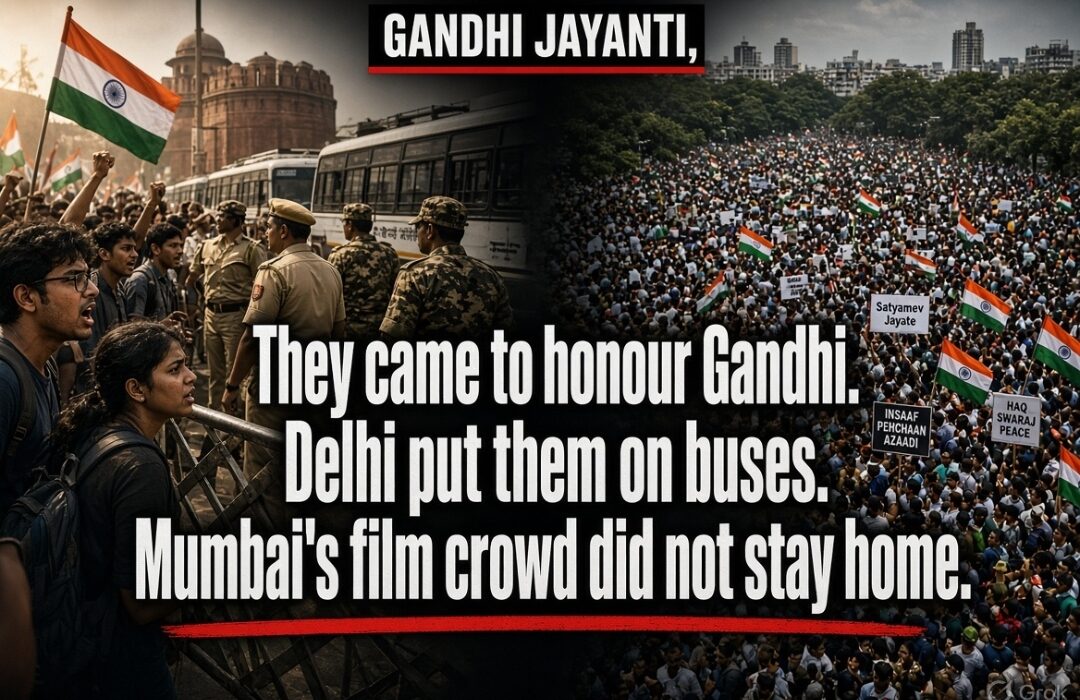
Delhi: homage that ended in a bus
The date was the homage. Cockroach Janta Party founder Abhijeet Dipke had set 2 October as the start of the agitation against Chief Election Commissioner Gyanesh Kumar, arguing that Gandhi had not waited for British permission either. Student groups took the same day: AISA, SFI, DYFI, NSUI and the Indian Youth Congress, alongside AAP and other opposition leaders, called people to Jantar Mantar over the Special Intensive Revision of electoral rolls.
Delhi Police denied permission and imposed Section 163 of the Bharatiya Nagarik Suraksha Sanhita in New Delhi district, barring assemblies, processions and slogans without written approval. Approaches from Ashoka Road, Janpath and Tolstoy Road were barricaded. Eleven metro stations, including Rajiv Chowk, Central Secretariat, Jantar Mantar and Patel Chowk, were closed. Reports also described mobile internet suspended around the site. Officers, with RAF and CRPF support, stopped people at the Parliament Street roundabout and loaded them into buses for Fatehpur Beri, Badarpur and other stations.
Police figures settled around 500 to more than 700 detained. Among them were former chief minister Atishi, AAP’s Saurabh Bharadwaj and Sanjeev Jha, Rajya Sabha MP Sanjay Singh, RJD’s Manoj Jha, CPI(M) leader Brinda Karat, AISA national president Neha Bora and Yogendra Yadav. Bharadwaj was picked up around 10.30 am, soon after he arrived. A police source told reporters that about 700 people from SFI alone were stopped at the Ashoka Road roundabout. Indian Express described officers waiting until a group grew past ten, then carrying people to buses. Atishi called it “barbarism and brutality” against a peaceful protest. Yadav, from inside a bus, said that on Gandhi Jayanti, in Gandhi’s country, the government was acting like the British.
That is the analytical core of the Delhi day. The Gen Z and student presence was real — campus organisations supplied much of the crowd — but it never became a sit-in at the designated site. The homage was the attempt to assemble on that date. The state’s answer was preventive: seal the road, cut the approach, detain first. Whether that meets the legal test of Section 163 is a separate question from the political one. A birthday the Republic spends praising non-violent assembly was the day the assembly was not allowed to form. Protesters call that an atrocity. Police call it order. What is not in dispute is the sequence: permission refused, site sealed, students and opposition leaders put on buses before a meeting could begin.
Mumbai: the pradarshan that was held anyway
Mumbai Police had also refused the Shivaji Park gathering, citing a 2013 Bombay High Court order and a 2016 state government order under which they said they could not clear a rally there, and advised another venue. Dipke answered with a “jail bharo” and went ahead. Routes from Dadar station were barricaded and about 300 personnel were deployed. The crowd still formed. Police put the number at about 4,000; organisers and several outlets described thousands, mostly young, with tricolours and placards reading “Gyanesh BRO, JUST RESIGN” and “Gyanu, Tujha Democracy Var Bharosa Nay Kay?”
Dipke opened with “Bharat Mata Ki Jai” and “Vande Mataram,” and called the Modi government incompetent for forcing a second protest within two months of the NEET sit-in that ended with Dharmendra Pradhan’s resignation. Sanjay Raut named it “Jantar Mantar in Mumbai Season 2.” Shiv Sena (UBT) and MNS were reported in support. Tushar Gandhi, Mahatma Gandhi’s great-grandson, was on the ground — the most direct family link to the day the students had chosen.
The Mumbai pradarshan worked because the city could not pre-empt it the way Delhi pre-empted Jantar Mantar. A denied permission and a barricaded station did not equal an empty park once enough people had already decided to come.
Who from the film world came
The names reported at the park, not merely online, are a short list.
Naseeruddin Shah met Dipke on the ground. In video shared by the CJP founder, Shah says he wants to thank him; Dipke, surprised, calls it a dream and captions the clip “Am I dreaming or what?” Shah had also spoken during the earlier NEET protests.
Shabana Azmi was reported among the protesters by Indian Express, Hindustan Times and Rediff, after she had already urged people to join with the line that a vote is a voice.
Vishal Dadlani came on stage with Dipke and Saurav Das, told the young crowd he was glad to see them, and led a “Go Gyanu Go.”
Times Now also reported filmmaker Vishal Bhardwaj and singer Rekha Bhardwaj spotted at the protest. Indian Express’s live account earlier in the day placed documentary filmmaker Anand Patwardhan among those present. Comedian Raunak Rajani was photographed at the rally.
Javed Akhtar was reported as backing the protest on X, not as having been on the ground. A support post is not an attendance.
The celebrity presence did not change the demand. It changed the photograph. A youth rally that already had a July win behind it — a 49-day Jantar Mantar occupation that coincided with a minister’s exit — now had Shah, Azmi and Dadlani in the frame. That is useful for reach. It is not evidence about electoral rolls. The argument those actors walked into is still the one in the Indian Express investigation of 23 September: Sandhu and Joshi objecting, on record, at least 14 times in 10 months to SIR decisions they said were taken without them. The Commission says the June 2025 order and later schedules were unanimous, and that the Form 6 declaration was upheld by the Supreme Court. Both claims are what Friday’s crowd was arguing about. The film names made the argument louder. They did not settle it.
