📰
Indian Politics
New-Age Chanakya Strikes: DK Shivakumar Storms Poll Office, FIRs Filed, BJP Accused of Plot to Wipe 15 Lakh Voters
The political reading that has long cast D. K. Shivakumar as Congress’s new-age Chanakya was never only about resort politics. It was about a method: read the opponent’s move before it lands, occupy the procedural ground the opponent thinks is neutral, and turn a technical dispute into a question of legitimacy. The October 1 press conference on Form 7, the FIRs already registered in Belagavi and Bhalki, and the sit-in at the Chief Electoral Officer’s office are that method applied to the electoral roll.
Shivakumar earned the Chanakya tag in 2018, when he held the Congress–JD(S) flock together and blocked what was then read as Amit Shah’s Operation Lotus. He kept it through raids, jail, and a decade of being treated as the party’s organiser rather than its face. When he took the chief ministership in 2026, the open question was whether the organiser could govern without losing the instinct that made him indispensable. Thursday’s sequence suggests he has not lost it. He did not wait for the Election Commission to finish verifying objections. He named a conspiracy, put numbers on it, tied it to communities that vote Congress, demanded criminal cases, and then physically occupied the CEO’s office until an inquiry was ordered. That is Kautilyan politics in a bureaucratic setting: control the narrative of the roll before the roll is final.
What actually happened on October 1
Form 7 is the statutory objection through which any elector can seek deletion of a name said to be dead, shifted, absent or duplicate. In a normal revision it is used sparingly, often by people removing their own names. Karnataka’s Special Intensive Revision is not a normal revision. The draft roll had already placed on the order of one crore voters in the absent–shifted–dead–duplicate categories, and the claims-and-objections window closed around September 23. Into the last days of that window came a burst of bulk Form 7s.
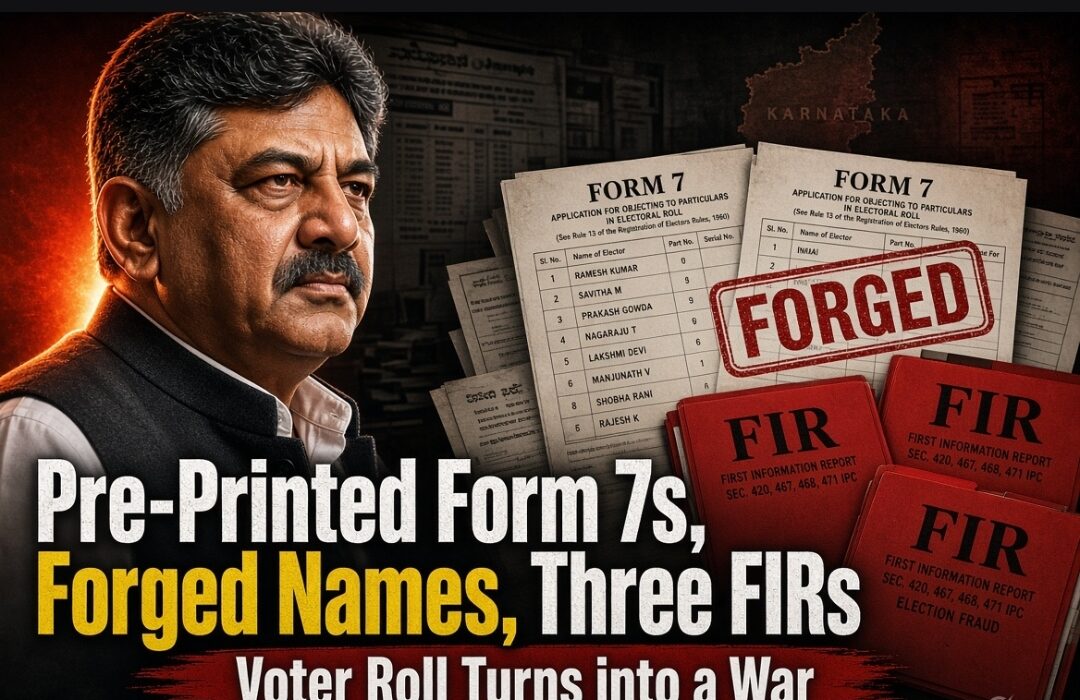
At a press conference with cabinet colleagues, Shivakumar called this a “big fraud” and a coordinated attempt by BJP and JD(S) workers to strike minority, Dalit, backward-class and slum voters off the roll. He said pre-printed forms, carrying names, addresses and EPIC numbers, were being submitted in more than 70 per cent of booths, and that agencies handling voter data had leaked it to party cadre. He put the plot at 15 to 16 lakh genuine voters, while also speaking of 45 lakh discrepancies and a wider design to remove 50 to 60 lakh. He cited booth-level piles: about 6,259 forms in Mudigere, 3,000 in Belagavi North, 2,285 in Bhalki, 1,373 in Babaleshwar, 1,200 in Narasimharaja, and over 13,000 in Vijayapura city, mostly against Muslim voters in a seat Congress won in 2023 by roughly 6,000. He said the printing was being directed from Delhi and Bengaluru, and that the Chief Election Commissioner could not be unaware.
He then did what a chief minister who still thinks like a party general does. He led ministers, including Priyank Kharge, M. B. Patil and others, to CEO V. Anbukkumar’s office, submitted a memorandum demanding a booth-wise probe and immediate FIRs, and said he would not leave until satisfied — cabinet meeting or not. Police had already registered three FIRs, two in Belagavi and one in Bhalki, with more expected; other reports also mention Mysuru and Bidar.
The evidence that is hard, and the numbers that are not
The Chanakya move only works if some of the facts are stubborn. Several are.
In Belagavi North, booth-level officers told reporters that two men claiming to be from the city corporation brought already-printed Form 7s seeking deletion of Muslim names at six polling parts. One hundred and ninety-eight forms stood in the name of BJP worker Shashikanth Jadhav, who denied filing them and said the signature was not his. Shivakumar’s comparison with the Aland case rests on that denial: bulk objections in a borrowed or forged name. In Vijayapura, seven workers linked to the BJP filed forms against more than 13,000 voters in two days, then withdrew them in writing after being warned that false grounds would invite action. A defeated BJP candidate in Belagavi North, and a district Yuva Morcha functionary, were cited in the memorandum as having acknowledged large filings through associates. A separate accounting of Form 10 summaries found that in Babaleshwar alone, ten people filed 1,363 objections on a single day, largely against Muslim voters outside their own polling stations, almost all citing “absent or permanently shifted.”
That pattern — concentration, pre-printing, last-72-hours timing, community skew, and at least one denied signature — is what makes a criminal inquiry reasonable. It is not what makes every figure Shivakumar used interchangeable.
The nearly one crore names already out of the draft roll belong mainly to the SIR’s own absent–shifted–dead–duplicate classification, reported elsewhere at about 1.08 crore, including 65 lakh marked shifted and 16 lakh marked dead. That is a different process from Form 7 objections filed by party workers in late September. Folding the draft-roll exclusions, the notice stage, and the objection spike into one “plot to delete 15 lakh” or “45 lakh” or “50–60 lakh” is campaign arithmetic. A serious probe has to separate enumeration error, ordinary migration, dead voters, and targeted objection. Shivakumar’s strength on Thursday was the specific piles and the FIRs. His vulnerability is the sliding total.
The other side of the roll
BJP state president B. Y. Vijayendra did not deny that his party had filed objections. He claimed the right to flag names it suspects were added illegally, spoke of Muslim voters being enrolled in batches at masjids and kalyana mantapas with officers present, and raised the allegation of Bangladeshi immigrants on the list in some constituencies. Verification, he said, belongs to the Election Commission; false forms will be rejected; an FIR is not a finding. “What is the crime in this?” he asked, and added that the party would not be threatened into retreat.
That reply is not empty. Form 7 exists precisely so parties and citizens can challenge the draft. A state government that treats every bulk objection as a conspiracy will, in time, make legitimate challenge look like an offence. The crime, if there is one, is not the form. It is forgery, pre-printed electoral data that should not be in party hands, objections filed without personal knowledge, and a community filter applied at industrial scale in seats where a few thousand names can flip the margin. Vijayendra’s immigrant claim is itself an allegation until the ECI tests it voter by voter. Both sides are currently asking the Commission to do their politics for them.
Why this is Chanakya, not only outrage
Three calculations sit under the press conference.
First, the national script. Congress has spent the past year arguing “vote chori.” Karnataka’s SIR, landing while Shivakumar is new in the chair, is the state chapter. By saying the duty to file the FIR lies with the Election Commission, and by naming the Chief Election Commissioner, he drags a constitutional body into a partisan frame before the final roll is published on the October calendar. That is risky institutionally and useful politically.
Second, the coalition inside his own party. The ministers on the stage and at the sit-in were not ornamental. A chief minister who still has a predecessor’s faction in the legislature needs a fight that every Congress MLA can join. Protecting “our” voters in Bhalki, Mudigere, Narasimharaja and Vijayapura is that fight. It also speaks to Muslims, Dalits and backward classes without a new welfare promise.
Third, 2028. Coastal and Mumbai-Karnataka seats, and urban pockets where the BJP’s booth machine is better than Congress’s, are where a cleaned or a tilted roll matters. If pre-printed Form 7s are real, the BJP has tried to do with paper what it once tried with defections. If they are inflated, Shivakumar has still fixed the story: any deletion between now and the final roll can be called theft. Chanakya did not wait for the verdict. He wrote the brief the court would have to answer.
The limit of the method is the same as in 2018. Resort politics worked because the numbers in the Assembly were countable. Roll politics will be judged by whether the FIRs produce forged signatures and a data trail, or only withdrawn forms and a press conference. Shivakumar said that if he fails to protect every voter he does not deserve the chair. The Election Commission, not the sit-in, will decide whether the chair was used to defend the franchise or to campaign on it. Until that inquiry is public, booth by booth, both the conspiracy and the denial remain ahead of the evidence.