Indian Politics
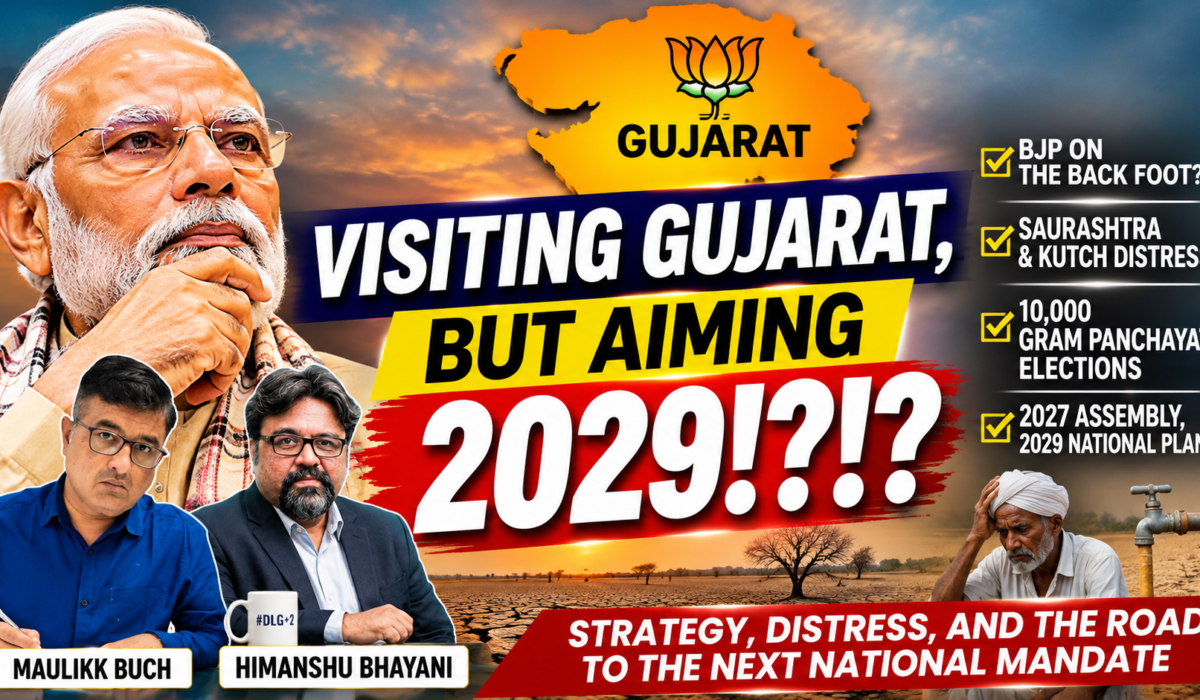
On or around 20 November 2026, the YouTube channel The India Wire (India News) streamed a nearly two-hour live discussion titled PART II – Visiting Gujarat: But Aiming 2029!?!? featuring commentators Maulik K. Buch and Himanshu Bhayani. The video’s description frames Prime Minister Narendra Modi’s recurring visits to his home state as containing a “secret plan for 2029,” claims that the BJP is “on the back foot for the first time” in Gujarat, and points to distress in Saurashtra and Kutch plus the dynamics of roughly 10,000 Gram Panchayat elections in famine-affected areas.
The core thesis of the stream is that high-visibility Gujarat visits are less about routine governance and more about early political firefighting and narrative preparation for the 2029 Lok Sabha elections, with the 2027 Gujarat Assembly polls as the immediate intermediate test.
Throughout 2026, Modi has made multiple trips to Gujarat. These have combined project inaugurations (for example, multi-thousand-crore infrastructure packages in Banaskantha and elsewhere), cultural and religious stops, and closed-door political engagements. A notable November 2026 visit involved a late-night meeting with Chief Minister Bhupendra Patel, Deputy Chief Minister Harsh Sanghavi, cabinet ministers, and senior organisational leaders. Mainstream reporting described the discussion as covering public outreach, cadre connect, preparations for the Vibrant Gujarat Global Summit 2027, and conditions on the ground, including drought-like situations in parts of the state.
The video’s framing treats these as evidence of urgency rather than strength. It asks why the Prime Minister needs to return so frequently if the political terrain is as secure as national projections suggest. Parallel reporting shows the BJP organising simultaneous New Year “Snehmilan” gatherings across all 182 assembly constituencies and directing ministers and MLAs toward intensive tribal and rural outreach—standard early-cycle mobilisation, but intensified relative to previous cycles.
The stream’s assertion that the BJP is on the defensive “for the first time” in Gujarat is the most contested element. Gujarat has been under continuous BJP rule since 1995 (with brief interruptions). The party swept the 2022 Assembly elections (156 seats) and has dominated local bodies. Amit Shah has publicly cited recent civic and rural poll results to project confidence for 2029.
However, the video points to specific pressure points that independent reporting also notes: pockets of discontent in Saurashtra and Kutch, competition from AAP in certain belts, and the need for sustained tribal outreach after setbacks in some local body contests. Long incumbency after three decades naturally generates fatigue. The BJP’s own internal responses—leadership rotation, fresh faces in cabinets, and intensive ground programmes—acknowledge that anti-incumbency must be managed proactively rather than ignored. The “back foot” characterisation is therefore interpretive: it is more accurate to say the party is treating Gujarat as a high-priority laboratory that still requires active maintenance than to claim systemic collapse.
The description highlights approximately 10,000 Gram Panchayat elections in famine-affected regions as a flashpoint. Rural local-body contests often surface issues of water scarcity, agricultural distress, and delivery of schemes more directly than Assembly or Lok Sabha polls. Saurashtra and Kutch have historically been sensitive to agrarian and climatic shocks. When such elections coincide with high-level political visits, opposition voices and critical analysts interpret the visits as damage-control or narrative-management exercises. Ruling-party voices counter that the same visits also allow the government to announce relief measures, infrastructure packages, and direct outreach, converting potential grievances into visible responses.
The explicit linking of current Gujarat activity to 2029 is the stream’s central analytical claim. Gujarat remains the organisational and narrative heartland of the Modi-Shah leadership. The “Gujarat model” of booth-level management, rapid leadership churn to blunt anti-incumbency, and development messaging has been consciously exported to other states. Frequent visits serve multiple simultaneous purposes: locking in the 2027 Assembly outcome, refining ground organisation, generating positive development imagery, and signalling national confidence. Whether this constitutes a “secret plan” or simply standard high-stakes political management is a matter of perspective. What is observable is that the timeline is deliberately early—activity in late 2026 is already calibrated toward the 2027 state election and, by extension, the national contest two years later.
The video offers a critical reading that emphasises vulnerabilities, rural distress, and the political intent behind the visit schedule. Mainstream coverage documents the same visits as a mix of development delivery, organisational review, and early election preparation without adopting the “back foot” or “secret plan” language. Both perspectives capture part of the reality: Gujarat’s long-term dominance does not eliminate the need for continuous maintenance, especially ahead of a national election in which the state’s performance will be treated as a symbolic and organisational benchmark.
The practical test will be the outcome of the 2027 Assembly elections and the subsequent local-body results. If the BJP retains a strong majority with limited losses in Saurashtra, Kutch, and tribal belts, the visits will be retrospectively judged as successful pre-emptive strategy. If margins shrink noticeably or opposition parties convert rural distress into seats, the critical framing advanced in the stream will gain greater weight. Until then, the pattern of high-level engagement in Gujarat remains one of the clearest indicators of how seriously the ruling party is treating the runway to 2029.