📰
Economy & Markets
A Tower Does Not Take a Whole Farm. In Jetpar, That Is Not Enough.
In Prime Minister Narendra Modi’s home state, thousands of Gujarat farmers have turned a transmission corridor into a political test — of compensation, consent, and whose land the “Gujarat model” is built on.
The story does not begin with an effigy. It begins with a survey number.
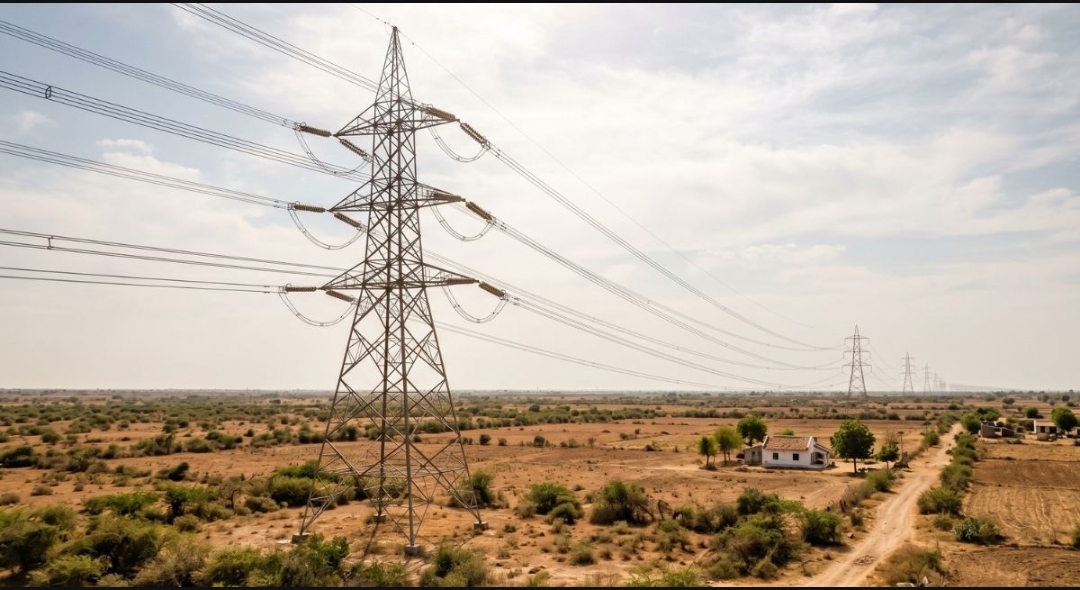
In Jetpar, in Morbi district, the first language is still the field: cotton, cumin, groundnut, pomegranate, castor. Then the maps arrived. A 765 kV line of Halvad Transmission Limited — a special-purpose vehicle of Adani Energy Solutions — was drawn from the Khavda renewable zone in Kutch toward Halvad. Later came an 800 kV stretch of Power Grid Corporation of India. Towers and right-of-way corridors cut through the same plots that had fed families for generations.
Officials have a clean sentence for this: a tower does not take a whole farm. Farmers keep a different ledger. One pad of concrete. A corridor that cannot be planted the same way. Lines that snap and fall. Land they say will never again be fully theirs. Yogesh Manilal Kadivar, a cotton farmer in Piludi, has said the two projects together account for more than 70 percent of his ten-bigha holding. Vinod Baval Aghara in Juna Devaliya said the value of his land had fallen from Rs 55–60 lakh to less than half after a 765 kV tower went up in 2025.
That arithmetic is why a village built a camp.
The cantonment in the Patidar belt
They called it Satyagraha Chhavani — a protest cantonment at Sardar Chowk in Jetpar. Shamianas. Dayro music. Shaved heads as a funeral for dignity. Women sitting through 40-degree heat. An indefinite hunger strike that began in mid-June and stretched into July. About 35 village heads backed the agitation. So did brothers of Kantilal Amrutiya, Morbi’s multi-term BJP MLA and a minister of state in the Gujarat government. Ratilal Shivlal Amrutiya, one of those brothers, later put the conflict in a sentence that is more dangerous for a ruling party than any slogan: “We are not against a political party, but against those in the government who are responsible for this issue. Jetpar is my ancestral home.”
The irony is local and sharp. This is Gujarat. This is the Patidar belt. This is the political geography that made the Prime Minister.
The state did move. In early July, after weeks of fasting and after the protest had already become politically expensive, the government agreed to shift the compensation base from jantri (circle) rates to market value and to pay double that amount — a change ministers described as fair and market-linked. Farmer leaders said: write it down. Issue a government resolution. Pay four times market value, as they said Rajasthan had done. Put a rent on every pole that stays. Do not fold consent into a Market Rate Committee that feels like a signature extracted under notice. Talks without paper were refused.
The formula now on the table, as farmer leader Nehul Dhirajlal Amrutiya describes it, is 200 percent of the value of the land under a tower base and 30 percent of the value of the right-of-way corridor. “This does not cover the entirety of losses,” he said. His alternative is not anti-electricity. It is anti-cheap-at-the-farmer’s-cost: take the line through the sparsely populated Little Rann of Kutch where possible, or put it underground where it cannot. “You cannot aim for a cheaper project at the cost of farmers.”
Kantilal Amrutiya, the minister whose own brothers sat in the camp, has drawn a harder line: the route will not change. “If they want, the first tower can be put up on my land itself.” He also says the new resolutions already give farmers three times what they would have received earlier. Between those two sentences — a brother’s field and a minister’s corridor — the whole argument of this protest lives.
From one village to nine thousand at the Collectorate
Work paused in places. Notices did not. On 23 September, landowners with towers or corridors on their fields were told to appear within two days before a Market Rate Committee to nominate a valuer, or the government would nominate one for them. Morbi Collector Swapnil Khare said the notices were only to start a process, that valuation would take 21 days, and that absentees would get another chance. He also admitted the process has been “crawling”: seven committees, 102 survey numbers valued, 44 farmers paid. He did not have an exact count of how many holdings are affected.
Farmers heard a clock, not a process. On 17 September — the Prime Minister’s birthday — some in Jetpar burned effigies of Narendra Modi and Amit Shah. Police booked 21 people. The case went to the Local Crime Branch. As of late September, no further action had followed, and protesters said some of those named were not even at the burning. The fire was theatre. The fuel was four months of unanswered land.
A week later, more than 9,000 farmers sat at the Morbi Collectorate. Nehul Amrutiya’s instruction had been blunt: call every man, woman and child. The question they shouted is the oldest one in a land-and-power state: “It is the business plan of a company, the compensation is to be paid by the company, then why is the government in their favour and not in that of the farmers?”
The protest is no longer only about one Adani SPV. It has become a revolt against the compensation policy itself, and against a larger map: Gujarat is laying high-voltage corridors across many districts to evacuate power from Kutch. Farmer organisations put the statewide stakes in large numbers — hundreds of thousands of families, thousands of hectares. Even if those estimates are contested, the political fact is not. Notices have gone out far beyond Jetpar. Solidarity has come from Ahmedabad, Jamnagar and other districts. Opposition parties have tried to stand in the frame. The camp does not need them to exist.
Two true things that refuse to cancel each other
Infrastructure is real. Power generated in Khavda has to travel. India cannot build a renewable grid on sentiment. A 765 kV line is not a rumour; it is steel, right-of-way, and a national plan.
Land is also real. A farmer who loses the middle of his field does not live in a corridor on a planning map. He lives in the missing harvest, in a sale price that collapsed after the tower arrived, in a snapped line that burnt equipment in August and was recorded as a diary entry instead of an FIR. He lives in the fear Ratilal Amrutiya named out loud: if the ceramic factories stumble, the young men of Morbi need a farm to come back to. A corridor that devalues that farm is not a technical detail. It is a closed door.
Arun Magan Sanavada of Vaghpar put the political wound in one line: “They keep praising the Gujarat model. But where is the Gujarat model when it needs to work for farmers?”
That is the article inside this agitation. Not a conspiracy, not a slogan, not a speech. A field that was asked to become a right of way, a government that raised the cheque and refused to move the route, a ruling-party household split between the ministry and the hunger tent, and a crowd of nine thousand asking why the state stands closer to the company than to the survey numbers it governs.
The camp is quieter on some days — mourning, heat, fatigue, the long wait for a written guarantee. The towers have not vanished. Neither have the people who plant around their shadows. The story is still open. It is being written in dust, in notices with two-day deadlines, and in the stubborn decision to stay on the land until the paper matches the promise.