Saturday, October 17, 2026  |  India Standard Time
⚡ Breaking
India GDP grows 7.2% in latest quarterSupreme Court rules on Electoral Bonds transparencyAI Governance Bill tabled in Parliament for discussionRBI holds repo rate steadyISRO announces next lunar mission timelineIndia GDP grows 7.2% in latest quarterSupreme Court rules on Electoral Bonds transparencyAI Governance Bill tabled in Parliament for discussionRBI holds repo rate steadyISRO announces next lunar mission timeline
Uncategorized

Leaderless Tricolour Protest Grows in Central Delhi Despite Heavy Security and Detentions

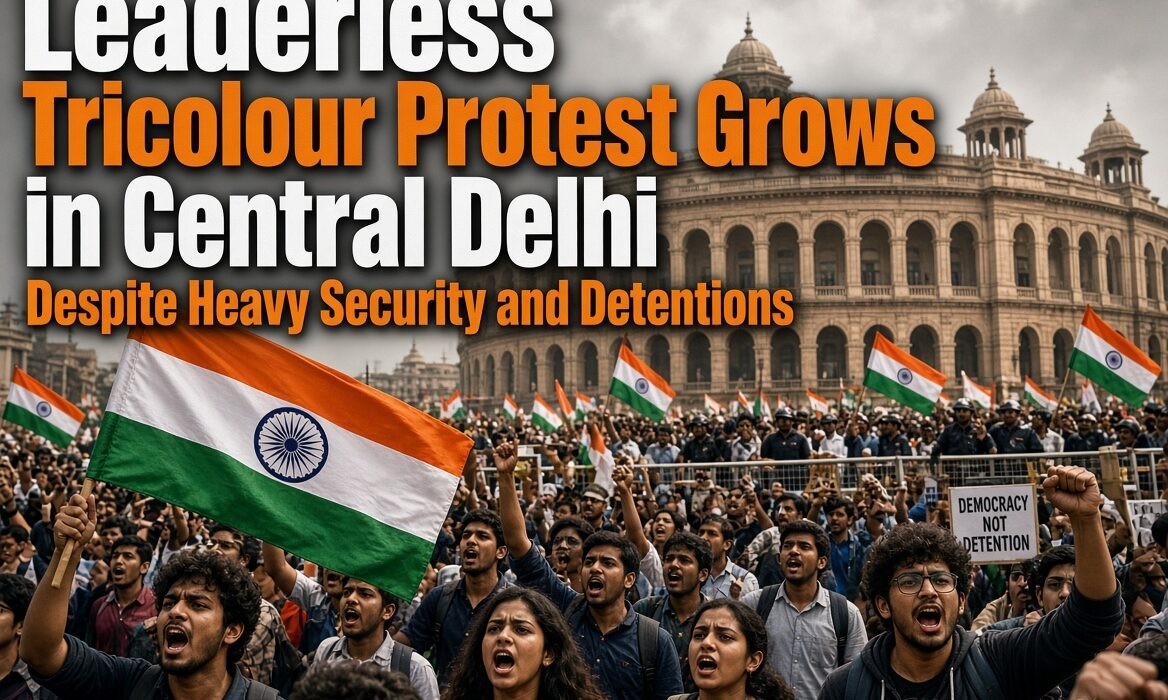
New Delhi, October 17, 2026 — A gathering of citizens waving the Indian tricolour and protesting alleged electoral irregularities escalated through the evening of October 16 in central Delhi. What began as a call to assemble at Central Park in Connaught Place expanded into repeated flash protests across adjoining areas, with participants continuing to arrive even as security forces made detentions and imposed restrictions.

The mobilisation followed a call for a “Lehra Do Tiranga” (Hoist the Tricolour) gathering, primarily demanding the resignation of Chief Election Commissioner Gyanesh Kumar over claimed irregularities in the Special Intensive Revision of electoral rolls. Authorities had closed Central Park for administrative reasons and enforced prohibitory orders under Section 163 of the Bharatiya Nagarik Suraksha Sanhita. Thousands of police and Central Armed Police Forces personnel were deployed with barricades and cordons. Founders and organisers of the call, including Abhijeet Dipke, along with student activist Neha Bora, were among those detained; overall detentions reached around 150.

Situation reports through the evening described an initially limited presence that grew as people continued to reach the area independently via metro and other routes. Early assessments indicated no large-scale mobilisation was expected. By later hours, detentions rose while crowds kept building, with participants stating they had come to hoist the national flag and express concern over the country’s institutions and democratic processes. Many of those present were young people who arrived on their own rather than under the direction of established political leaders. Slogans focused on institutional accountability, criticism of electoral processes and earlier police actions, and national pride. Similar tricolour-related gatherings were reported in other cities.

Despite large deployments of police and paramilitary forces and cordoned zones, people continued to arrive and regroup in stretches of Connaught Place, Mandi House and nearby areas. Conversations with participants indicated they had travelled from multiple states and viewed the act of unfurling the flag as a response to perceived threats to voting rights and constitutional norms. By late evening the gatherings had spread across central Delhi, with numbers rising into the thousands according to field accounts. Security measures and detentions did not halt the inflow, and the movement proceeded without prominent opposition political leaders present on the ground to direct it.

The events form part of a series of recent mobilisations in the capital over electoral-roll concerns and the right to protest, following earlier actions at Jantar Mantar—which has since been denotified as a designated protest site—and related detentions. The October 16 developments showed that public participation continued despite preemptive security measures and the absence of conventional political leadership on site.

m
Written By

maulikk.buch@gmail.com

Maulikk Buch is a senior journalist and one of India’s most respected political analysts with over 25 years of experience in journalism, political reporting, and in-depth analysis. Based in Vadodara, Gujarat, he is widely recognized for his sharp insights into Indian politics, policy, elections, and governance at both the state and national levels. With a career spanning more than two and a half decades, Maulikk Buch has built a reputation for delivering accurate, ground-level reporting combined with sharp analytical depth. He is the Founder and CEO of Reopinion Media and Communications and serves as the driving force behind The Analysis (theanalysis.in) — India’s dedicated platform for detailed, evidence-based political and policy insights. Expertise & Strengths Maulikk Buch specializes in: Indian national politics and electoral analysis Expertise on Gujarat ,UP, Bihar ,West Bengal political developments Legislative and policy tracking Crisis communication and political strategy His work stands out for its hyperlocal authenticity combined with a strong national perspective. He is known for precise political forecasting, having delivered highly accurate predictions during Gujarat’s municipal and assembly elections. Reputation Management & Media Consulting In addition to his journalistic work, Maulikk Buch is a seasoned reputation management and media consultant. He has successfully guided and supported over 120 clients across India in public relations (PR), crisis management, digital reputation cleansing, and strategic digital marketing. Current Role As Editor-in-Chief and lead political analyst at Reopinion Media Network, Maulikk Buch oversees a group of digital news platforms including The Barodian (thebarodian.in), The Analysis, and several other specialized verticals. He regularly contributes sharp, no-nonsense commentary on Indian politics, opposition strategies, and governance challenges. His writing and analysis are frequently referenced by political observers, journalists, and readers seeking clear, fact-based understanding of complex political developments across India. Maulikk Buch continues to be a trusted voice in Indian journalism, combining deep on-ground reporting with thoughtful national analysis and strategic media advisory.

View All Articles →

Related Analysis

📰
Uncategorized

Hello world!

maulikk.buch@gmail.com

Add to the Discussion

Your email address will not be published. Required fields are marked *

THE ANALYSIS: Accurate | Unbiased | Insights
Privacy Overview

This website uses cookies so that we can provide you with the best user experience possible. Cookie information is stored in your browser and performs functions such as recognising you when you return to our website and helping our team to understand which sections of the website you find most interesting and useful.