📰
Economy & Markets
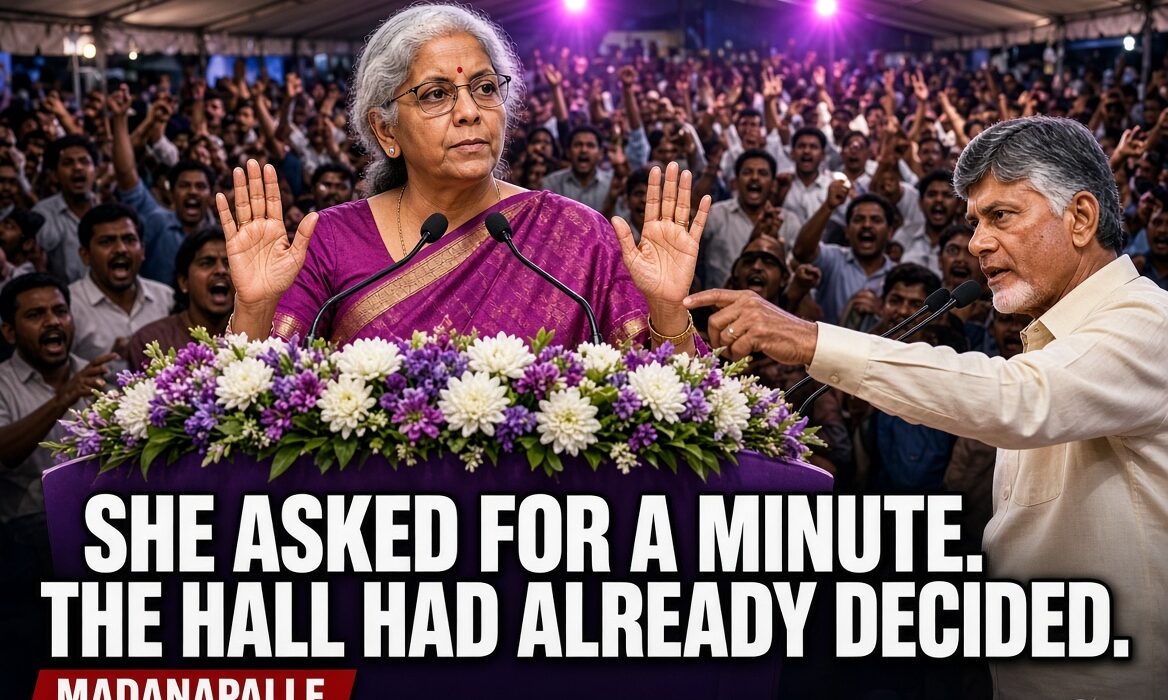
On 2 October 2026, Union Finance Minister Nirmala Sitharaman stood up in Annamayya district to speak at the foundation of a Rayalaseema horticulture project priced at about ₹1 lakh crore. The Indian School of Agriculture was on the same programme. Andhra Pradesh Chief Minister N. Chandrababu Naidu was on the dais. So was Anant Ambani. This was not an opposition rally. It was an allied government’s showpiece, built to tell farmers that a dry region was about to be rewritten.
Then the hall rose. Whistling, shouting, slogans. Sitharaman stopped, lifted both hands and asked, in Telugu, for one minute of silence. Naidu took the microphone. He told people to sit. He said he understood the enthusiasm. He said slogans could wait until they stepped outside. He called it a programme that would change farmers’ lives, and he said the central minister’s message mattered. She resumed.
That is the clip. A post by @Rajababu4you, already past 20,000 views by the evening of 4 October, supplied the rest: Andhra had hooted “Nirmala aunty,” denied her the mic, and the government would still not understand, because official GDP does not say whose development is happening. Other posts turned the noise into a “jobs first” protest. Local Telugu coverage, including a VSB TV report, described party workers forcing a pause. NewsDrum’s reading is the only one the tape can carry: an interruption, an intervention, no proven trigger. The jobs claim travelled later. Navbharat Times reported shouting and hooting and tied it to farmers seeking local work.
The gap between the tape and the caption is the story. One tent did not prove a national revolt. A messy interruption was instantly readable, to a large audience, as anger at the finance minister. That reading only lands if she is already the face of the grievance.
She has become the receipt
Sitharaman has held finance since 2019, longer than any recent predecessor. In a government built around the prime minister, she is still the person who reads out the slab, the GST rate and the deficit. When the household budget feels wrong, the complaint needs a name. She is the name.
The grievance has three layers, and they do not point the same way.
Jobs come first, especially for the young. Headline growth has been the government’s alibi for most of her tenure. The lived complaint is that the growth has not produced enough stable, local work. A horticulture hub and a data-centre memorandum can be announced in the same season as a hall full of people who do not believe either will hire them. Public-sector bank staffing has thinned over the decade, which feeds a sharper suspicion: the formal state is shrinking while the investment headline grows. Madanapalle sat on that line. A farmer-facing project, a central minister, a restless floor. Whether the noise was cadre, job-seekers or both, the viral edit chose the reading that already had an audience.
The salaried middle class is the older and more specific anger. Income-tax payers are few, highly visible in every budget speech, and unable to slip the net the way much of the cash economy still can. Collections have risen hard. In the Rajya Sabha in February 2026, Sitharaman called that formalisation, not suppression: more filers, higher reported incomes, not a heavier rate on the same people. The ministry cites a tax-to-GDP ratio of about 18.4 percent for 2025–26, low among comparable G20 developing economies, and points to slab changes, a higher rebate threshold and a simpler GST.
The counter is about the mix, not the average. Corporate tax was cut. The salaried taxpayer watched surcharge, cess and compliance tighten. GST is no longer the 28 percent maze of 2017, but it is still on the weekly bill. Capital-gains changes and the new regime’s bargain — lower rates, fewer deductions — landed on people who had already built their plans around the old one. Former Infosys CFO T. V. Mohandas Pai has said the quiet part in public: the middle class is angry about high taxes and a poor quality of life. Self-described long-time BJP voters now name Sitharaman as the reason they may not return in 2029. That is not a poll. It is the same complaint in a different register.
The third layer is the gap between the macro number and the weekly bill. “Fake GDP” in the Madanapalle caption is a slogan, not an audit. India’s accounts are imperfect, the informal sector is still badly measured, and no large statistical system is clean. The political use is simpler. People hear 7 percent and then meet vegetable prices, school fees, rent and an EMI that did not grow at 7 percent. The minister who defends the number inherits the distrust of the number.
What the anger deletes
A strong account has to keep the other side of the ledger, or it becomes another caption. The same tenure cut the headline corporate rate, pushed a cleaner GST structure, raised the point at which many salaried people pay no income tax, and watched public-sector banks move from a bad-loan crisis to record profits. Welfare delivery, from free foodgrain to direct transfers, is larger than it was in 2014. UPI remains free for consumers; the recent fight has been over merchant charges, which she has said will not be passed on. None of that cancels a thin job market or a squeezed household. It does kill the line that she has done nothing.
There is also a coalition fact the viral post skips. Naidu leads a party allied with the Centre. His intervention was crowd control in defence of the programme, not a rebuke of the minister. If the disruption was mostly workers showing off, the internet turned a discipline problem into a verdict. If it was farmers and the unemployed, then an ally’s event became the place the complaint surfaced. That is more awkward for the government than a Congress march. You can ignore the opposition. You cannot ignore your own tent.
The cost of a pause
Finance ministers do not win popularity contests. The job is a sequence of refusals. Sitharaman’s exposure is that she has become the explanation for every friction in the growth story: tax, price, job, exam, state share. Some of that is fair. The Union budget is where those choices are made. Some of it is displacement. State capital spending, education policy, oil prices and a young population entering a slow formal market are not hers alone.
The risk is not one interrupted speech. It is that the interruption no longer needs a caption. A crowd, a pause, a chief minister asking people to sit, and a large share of viewers already know what they think it meant. That is how frustration hardens. It stops waiting for the next budget line. It starts treating the minister as evidence.
Madanapalle does not prove that Andhra has turned on the Centre. It proves something narrower and more useful. The official story of development, told by the person who manages the country’s money, can no longer assume a quiet hall.