
Indian Politics
EXCLUSIVE ANALYSIS: Adani Stays, Ambani Goes: The Slide That Recast Rahul Gandhi’s Attack
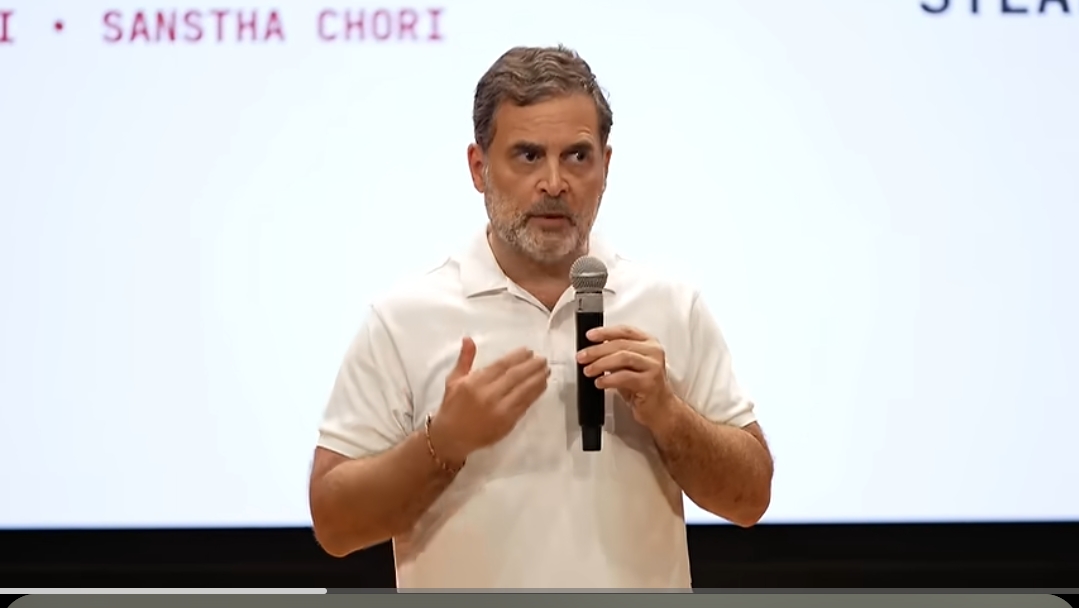
Rahul Gandhi’s latest “destroyers of democracy” presentation dropped Mukesh Ambani from a familiar lineup of faces. The change is small on a slide and large in the political reading of it.
On Thursday, 24 September 2026, Leader of Opposition Rahul Gandhi used a press interaction at Indira Bhawan in New Delhi to escalate his “vote chori” campaign. He described alleged manipulation of electoral rolls and institutions as an attack on the Constitution, called for Chief Election Commissioner Gyanesh Kumar’s resignation, and asked Kumar to “turn approver.” He said Prime Minister Narendra Modi and Home Minister Amit Shah sat “at the top” of what he termed a conspiracy and would eventually face investigation.
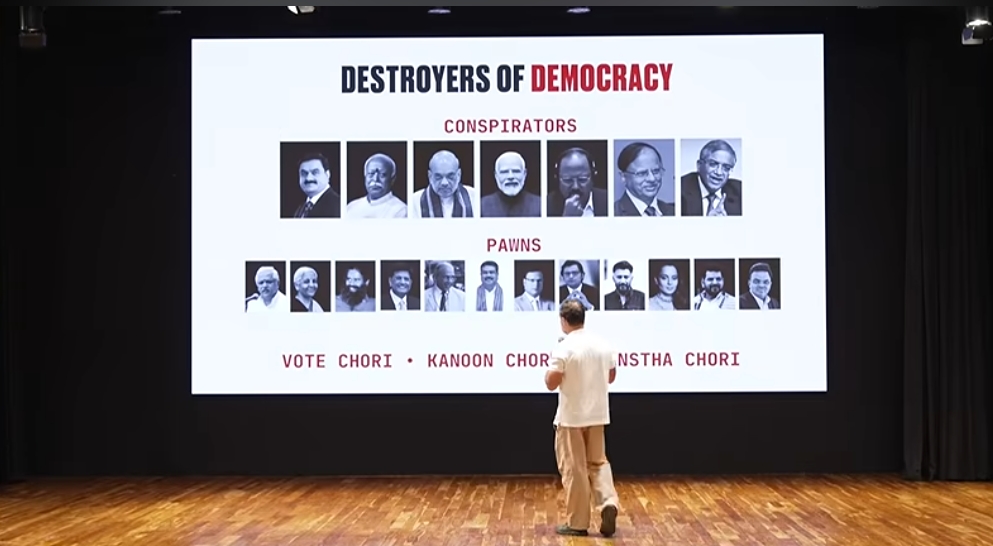
The visual that travelled fastest was the slide of photographs.
What changed on the slide
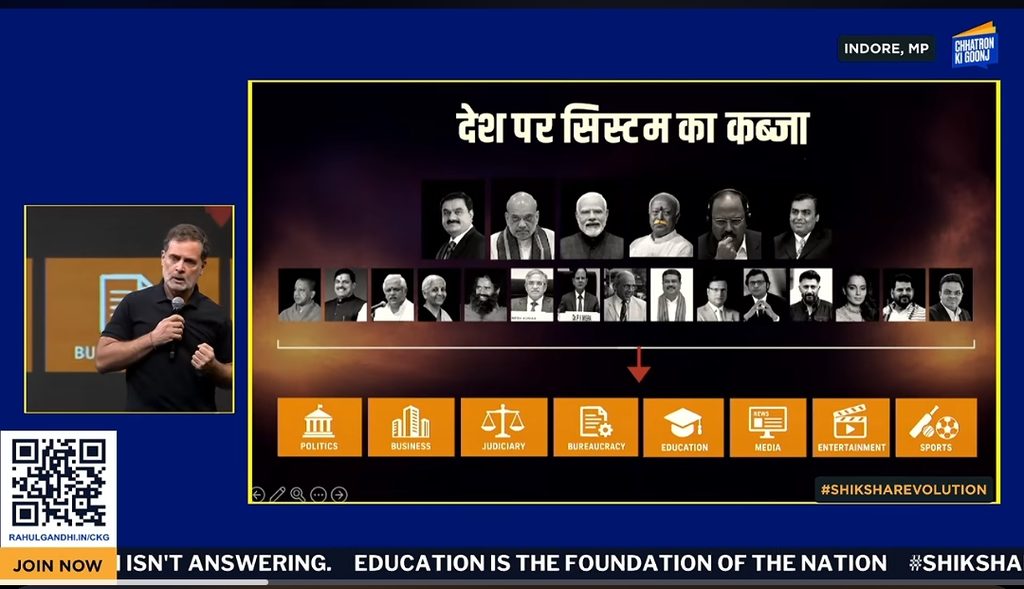
At earlier “Chhatron ki Goonj” events, including one in Indore, Gandhi’s presentation had grouped photographs of Modi, Shah, RSS chief Mohan Bhagwat, National Security Adviser Ajit Doval, Gautam Adani and Mukesh Ambani under the line “The system has captured the country.”
At Indira Bhawan the title became “Destroyers of Democracy.” Ambani’s photograph was gone. In its place appeared P.K. Mishra, Principal Secretary to the Prime Minister, and CEC Gyanesh Kumar. Adani remained in the frame along with Modi, Shah, Bhagwat and Doval. Gandhi labelled the top row “conspirators” and others “pawns.” He used the word deshdrohi for those he said had attacked the vote.
The omission is conspicuous because Gandhi has spent years naming both industrialists together. He skipped the Ambani family wedding in 2024 while other opposition figures attended. He has repeatedly alleged that public resources and policy have been steered toward a small set of business houses. The pairing of Adani and Ambani has been a staple of Congress campaign rhetoric since before the 2024 Lok Sabha election.
The immediate political context
The presentation did not appear in a vacuum. It followed an Indian Express report that two Election Commissioners had formally objected, over months, to decisions linked to the Special Intensive Revision of electoral rolls. Opposition parties treated that report as confirmation of their charge that the Commission had been captured. They demanded Kumar’s removal, a Supreme Court-monitored inquiry, and in some cases impeachment. Priyanka Gandhi Vadra called tampering with rolls “treason.”
Gandhi’s argument is now institutional as much as personal. He claims vote theft leads to “kanoon chori” and then “sanstha chori” — theft of law and of institutions. The inclusion of the CEC and the Prime Minister’s principal secretary on the new slide is meant to show the alleged capture running through the bureaucracy and the poll body, not only through party and capital.
Whether those charges hold is a legal and political fight still unfolding. The Election Commission and the government reject the “vote chori” framing. No court has yet ruled that the 2024 general election or subsequent Assembly polls were stolen. Gandhi says more evidence will become public in coming months.
Why Ambani’s absence is being read so closely
In Indian politics, who is left off a poster can matter as much as who is on it.
One reading is tactical. Gandhi is concentrating fire on the Election Commission and the officials he says executed or shielded the SIR process. Adding Mishra and Kumar sharpens that institutional attack. Dropping one industrialist may simply be a tighter narrative: the “system” as state power plus one dominant corporate group plus the RSS leadership, rather than a longer gallery of billionaires.
Another reading is that relations among political power, Adani Group and Reliance are not identical. Adani has faced a U.S. bribery case that was settled in court; the opposition treats that as proof of a privileged nexus. Reliance’s political history is older and more complicated. Mukesh Ambani’s father built influence across governments. There were well-documented tensions between Reliance and Rajiv Gandhi’s government in the 1980s, later periods of accommodation, and years in which Congress itself was accused of proximity to the same houses it now attacks. Gandhi has been more consistent than many in his party in keeping both names in speeches. That is why the missing photograph stands out.
A third reading, common in Delhi’s political gossip, is that corporates watch opposition rhetoric for signals about future risk. A list that once treated Ambani and Adani as a pair, then suddenly treats only one as a “destroyer,” invites speculation about conversations, donations, legal exposure, or a calculation that one house is less useful as a political symbol than the other. None of that has been documented in public filings around this particular slide. It remains inference.
What is documented is the money trail that made such lists politically potent in the first place. Electoral bonds, struck down by the Supreme Court, channelled the large majority of disclosed corporate funding to the BJP. Opposition parties argue that agencies such as the Enforcement Directorate and CBI were used selectively against businesses seen as close to them, shrinking the financial base of alternative politics. Supporters of the government reply that enforcement follows the law and that Congress’s own history with industrialists is hardly clean.
What follows
Gandhi has set a political clock of sorts: pressure on the CEC, talk of nationwide agitation if institutional answers do not come, and a claim that Modi and Shah will not escape scrutiny. The opposition wants Gyanesh Kumar out. The government shows no sign of yielding that ground.
The slide change will not decide that contest. It does, however, illustrate how opposition strategy now works: a recurring visual of “who captured the system,” updated as the fight moves from crony capitalism in the abstract to the Election Commission in particular.
Ambani’s disappearance from one deck of photographs does not mean Gandhi has made peace with Reliance, or that Adani is now the sole corporate villain in Congress messaging. It means the current battle Gandhi wants to fight is over the vote and the Commission. The older charge — that a handful of business groups and the ruling establishment grew together after 2014 — remains in the speeches. Only the faces on Thursday’s screen were rearranged.
Whether that rearrangement was editing, strategy, or a hint of a shifting corporate-political map is the question the missing photograph leaves hanging.
Related Analysis

📰