📰
Indian Politics

New Delhi, September 24, 2026 — Leader of the Opposition Rahul Gandhi on Thursday accused Chief Election Commissioner Gyanesh Kumar of orchestrating “vote chori” in the Lok Sabha and Assembly elections, demanded his immediate resignation, and said the Modi government had chosen a man whose appointment he had opposed and then insulated him from the law.
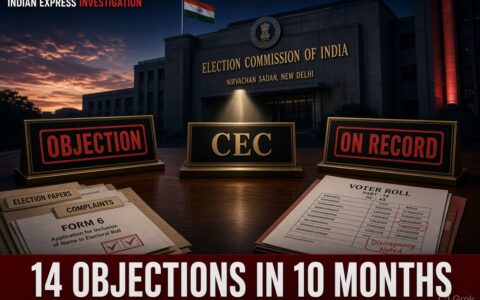
Addressing a press conference after an Indian Express investigation reported that two Election Commissioners had formally objected, on record, at least 14 times in 10 months to decisions around the Special Intensive Revision (SIR) of electoral rolls, Gandhi framed the dispute as more than a bureaucratic quarrel. He called it an attack on the Constitution itself.
“This is not just some small rigging of an election. This is an attack on the Constitution of India. This is an attack on the legal structure of our country, and you are the man who is supposed to ensure that the vote was protected,” he said, addressing Kumar directly. He claimed Congress now had “more than enough information” to assert, with “100 per cent certainty, not 99 per cent,” that the 2024 Lok Sabha election and subsequent Assembly polls were being rigged.
“I opposed his appointment”
Gandhi returned to a fight he first recorded in February 2025, when Gyanesh Kumar became the first CEC appointed under the Chief Election Commissioner and Other Election Commissioners (Appointment, Conditions of Service and Term of Office) Act, 2023.
That law replaced the earlier arrangement shaped by a March 2023 Supreme Court order, which had put the Prime Minister, the Leader of the Opposition and the Chief Justice of India on the selection panel. Parliament then reconstituted the panel as the Prime Minister, the LoP and a Union Cabinet minister nominated by the Prime Minister — a 2–1 government majority. Gandhi submitted a dissent note calling the midnight appointment “disrespectful and discourteous” while the law itself was still before the Supreme Court. The government went ahead. Kumar took charge on 19 February 2025.
On Thursday he said that dissent had been ignored for a reason. “Gyanesh Kumar was chosen by the Prime Minister. Not by anybody less.” Action on his later letters against the CEC, he alleged, never came because “the Prime Minister and Shah protect him.”
The law that, he says, put the CEC above the law
Gandhi pointed to two features of the 2023 Act.
First, the selection committee itself: with two of three votes controlled by the executive, he argued, independence is structurally compromised.
Second, the legal shield. Section 16 of the Act says no court shall entertain or continue civil or criminal proceedings against the CEC or an Election Commissioner for anything done, or claimed to be done, in the discharge of official duty. Gandhi’s case is that this protection was designed so that the occupant of the office could not be easily held to account. The Election Commission and the government have long described the clause as protection for official acts, not a blanket immunity from every crime.
That distinction is now the political battlefield. Gandhi’s line is simple: a referee chosen by the ruling side, then wrapped in statute, cannot be trusted when the voter list itself is in dispute.
Why anti-incumbency “stopped working”
He used a historical comparison to press the charge. In India, he said, every government eventually faces anti-incumbency. Indira Gandhi lost after winning the Bangladesh war. So why, he asked, did the same force not operate against the BJP in states where the party kept winning?
His answer: the vote itself had been captured. If the ballot is compromised, anti-incumbency has nowhere to land. That, he said, is why Congress has held three press conferences on SIR and voter rolls since 2025, called the Commission the government’s “B team,” and alleged collusion with the BJP.
From stolen votes to illegal laws
The sharpest part of Thursday’s argument was the chain he drew.
The vote gives the Constitution its force. The Constitution produces laws. Laws produce institutions. Break the first link, he said, and the rest collapse.
“Vote chori leads to kanoon chori, and from there to sanstha chori. If the vote has been stolen, and the MPs sitting in Parliament are there based on a stolen vote, then any law they are making is illegal.” He added that he had “no doubt” this would become fully clear to the country within six months.
He claimed the two other commissioners, Sukhbir Singh Sandhu and Vivek Joshi, were now saying Kumar was responsible for damage to the voting system — and that their letters produced no consequence because Kumar had “protectors” above him. “Please understand what these two gentlemen are saying. They are saying that the vote does not exist in India anymore.”
What the Express report actually said
The immediate trigger was not a new Congress document. It was an investigation published on 23 September reporting that Sandhu and Joshi had objected, in writing, at least 14 times over ten months — four times on a single day — to decisions they said were taken without their knowledge. The disputes, according to that report, covered Form 6 for new voters, additions and deletions during SIR, restoration of names, appeals, and the centralisation of voter-database access in Delhi. Copies of some objections were also sent to the Cabinet Secretary.
Congress has used the numbers from the SIR rollout as political ammunition: about 13.8 crore names removed from draft rolls across 31 states and Union Territories in early phases, with notices issued to crores of “doubtful” voters. The party’s case is that a cleanup sold as hygiene became a tool to shrink inconvenient electorates. Those figures are from the draft-roll process; they are not, by themselves, proof of partisan deletion. That is the gap Gandhi is trying to close with the internal dissent.
A year-long war over the referee
Thursday was not a sudden explosion. It was the latest peak in a conflict that has run since Kumar’s elevation.
Gandhi’s 2025 presentations on Mahadevapura in Karnataka and on Haryana alleged duplicate entries, fake addresses, bulk registrations and misuse of Form 6. The Commission rejected those charges. Opposition parties later filed notices in Rajya Sabha seeking Kumar’s removal, citing the selection process, his public confrontation with Gandhi, and the SIR. Those notices remain pending. After the Express report, the INDIA bloc again demanded his ouster, a Supreme Court-monitored inquiry, and a pause on SIR. Some leaders have spoken of impeachment in a special session.
Kumar’s office is one of the last institutions the Opposition still treats as capable of deciding who governs India. That is why the language has gone from “irregularities” to “treason.” On Wednesday Gandhi wrote that vote theft was “a crime against the Indian people and a direct attack on our Constitution,” and that “the BJP, RSS and EC who organised it have committed an act of treason.” On Thursday he told Kumar to resign at once. “What you have done is against India. You were meant to protect the vote. There will be consequences.”
What is actually at stake
Two things can be true at once. Internal disagreement inside a three-member Commission is not, by itself, proof that elections were stolen. And a selection system that gives the executive two votes out of three, plus a statutory shield for official acts, is a legitimate subject of democratic suspicion — especially when tens of crores of names are being moved on and off the rolls.
Gandhi is betting that the public will treat the second fact as the explanation for the first. The government and the Commission are betting that voters will see a losing party trying to rewrite results it could not win at the booth.
The CEC has not resigned. SIR has not been halted. The Supreme Court already has pieces of this dispute before it. Gandhi says the country is in a place it has never been since 1947, and that “our elections are fundamentally broken.” That is the charge. The evidence, the rebuttal, and the institutional response will now decide whether it remains a campaign slogan — or becomes a constitutional crisis.