📰
Society & Culture
Ten Million Chants Against Global War: The Untold Story of Delhi’s 1944 World Peace Mahayagya
By Maulikk Buch
In the winter of 1944, the world was hemorrhaging. Across Europe, the Pacific, and North Africa, the Second World War was devouring millions of lives, reducing historic cities to ash, and straining humanity’s moral conscience to its breaking point. Yet, thousands of miles away from the front lines, on the sandy banks of the Yamuna River opposite Delhi’s Red Fort, India’s spiritual vanguard mobilized an extraordinary counter-offensive—not with artillery, but with fire, sacred wood, and the ancient vibrations of Vedic mantras.
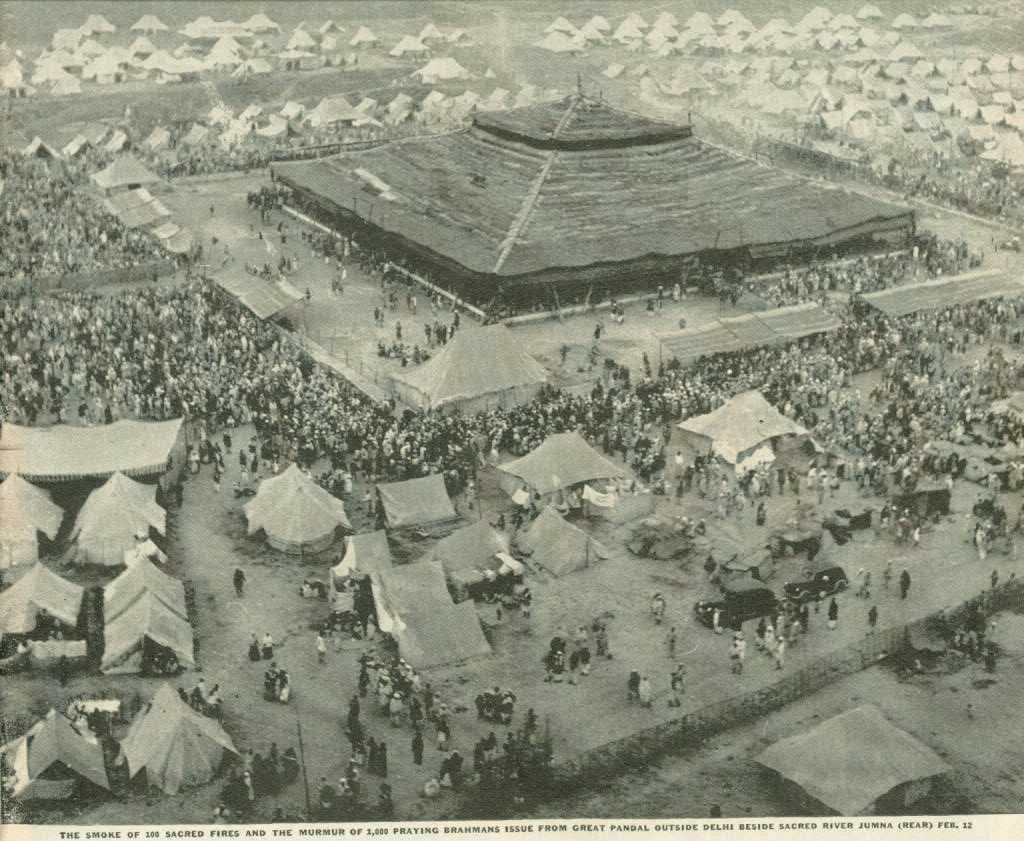
This was the Shatmukh Koti Homatmak Mahayajna—a monumental 11-day spiritual assembly organized to secure universal peace through Vedic science.

The Vedic Science of Disinfection and Mind Waves
The endeavor was rooted in classical scholarship. Planners consulted the revered Benares scholar Balaastri Vaidya, who verified that the Atharva Veda contained explicit, ancient rites designed specifically to avert global catastrophe and restore universal equilibrium.
To modern observers, the notion of altering the trajectory of a world war with ritual fire might have seemed quaint, but the leaders of the ritual framed it through systematic physical and psychic principles. Swami Shri Yogeshwaranand Teerthaji Maharaj, the Shankaracharya of Govardhan Math (Puri), articulated the mechanics with striking lucidity in fluent English:
“From the temporal point of view these yajnas are performed to produce vayu (gases) to destroy the evil forces affecting the human body and mind. You may call it ‘disinfection.’ In the old days yajnas used to be held for 12 years at a stretch. On the spiritual side, recitation of mantras from holy Vedas leads to concentration of mind, and the sound waves produce electro-magnetic waves which influence men’s minds.”
By recalibrating atmospheric qualities and broadcasting focused mental vibrations on an unprecedented scale, the organizers intended to soften the belligerent impulses governing world leaders.
Engineering an Architectural Wonder on the Yamuna
Transforming this vision into reality required an immense logistical operation, spearheaded by the fiery ascetic Swami Karpatri (a disciple of Swami Brahmananda Saraswati) and supervised by Swami Krishnabodhashramji.
Beginning on Basant Panchami (January 30, 1944) and running through February 9, an open stretch of land near Civil Lines was transformed into a sacred city:
- The Mandap: A temporary open-air pavilion spanned several acres, supported by towering 20-foot bamboo pillars thatched with palm fronds and straw.
- Spiritual Fortification: Before the fires could be struck, priests performed a strict Vastu Puja to seal the perimeter against negative entities, encircling the sprawling pandal with continuous cordons of consecrated thread, milk, and water. Protective cords were bound around every supporting pillar to grant spiritual stability.
- The Hundred Kundas: Beneath the thatched canopy lay 100 ceremonial fire pits (havana kundas), hand-dug and insulated with sacred river clay.
- Cosmic Alignment: Guarding the sanctuary were ten distinct flags representing the Dashadikpala, the guardians of the compass directions, zenith, and nadir:
- East (Indra): The golden Vaijayanta Dhwaja, bearing the thunderbolt (Vajra) or royal elephant Airavata.
- South (Yama): Dark blue-black, stamped with the staff of cosmic justice (Danda).
- West (Varuna): Oceanic white, depicting the aquatic Makara.
- North (Kubera): Gold and green, marked with the emblem of cosmic wealth.
- Southeast (Agni): Flaming saffron-red.
- Southwest (Nirrti): Velvet charcoal, warding off misfortune and decay.
- Northwest (Vayu): Smoky grey, celebrating the breath of life (Prana).
- Northeast (Isana/Shiva): Pure white, displaying the trident (Trishula).
- Zenith (Brahma): Lotus-pink and orange, looking toward celestial creation.
- Nadir (Ananta Shesha): Deep purple-black, honoring the primordial subterranean serpent.
The Strictures of Orthodoxy: A Bride of Grass
Every aspect of the ritual adhered strictly to traditional injunctions. Because the presiding Shankaracharyas and sannyasis had renounced all worldly ties to pursue solitary contemplation and prayer, they were strictly forbidden from offering oblations into the fires.
The mantle of Yajaman (the primary patron and commissioner) was bestowed upon Brahmachari Shri Jeevandattaji of Marwar. However, learned vidvans from South India raised a valid scriptural challenge: Vedic injunctions mandate that the patron of such rites must be a householder (grihastha).
To satisfy both scriptural law and the ascetic’s vow, an ingenious ritual solution was found: an authentic Vedic wedding ceremony was staged on site, wherein Brahmachari Jeevandattaji took a consecrated bundle of sacred grass as his ceremonial bride, granting him the required ritual status without breaking his vows.
The Mathematics of One Crore Offerings
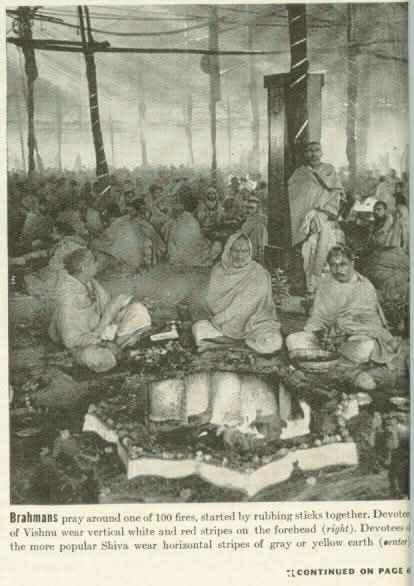
The scale of the devotion was mathematically staggering. The fire itself was not lit by ordinary matches, but sparked using the friction of sacred wooden aranis, then reverently carried from kunda to kunda.
Around these 100 kundas sat 1,500 disciplined pandits—15 assigned to each pit:
- Operating in rotating teams of five on two-hour shifts, each kunda maintained an uninterrupted six-hour daily barrage of recitation.
- Every shift continuously chanted the venerable Gayatri Mantra:
\text{ॐ भूर्भुवः स्वः तत्सवितुर्वरेण्यं भर्गो देवस्य धीमहि धियो यो नः प्रचोदयात्।} - Over the course of the 11 days, the Gayatri Mantra resounded exactly 10,000,000 (one crore) times.
- Concurrently, the flames were stoked with sacred wood—peepal, banyan, goolhar, and dhak—and fed with an equal number of 10,000,000 oblations (ahutis) of shankalya (or charu), an aromatic, nutrient-rich blend of rice, wheat, copra, barley, mustard seed, sesame, sugar, pure ghee, and wild honey.
While the smoke curled skyward, four learned Brahmins sat at the four cardinal corners of the pandal during the daily intermissions, continuously chanting the four Vedas in complete unison.
A Unified Spiritual Front
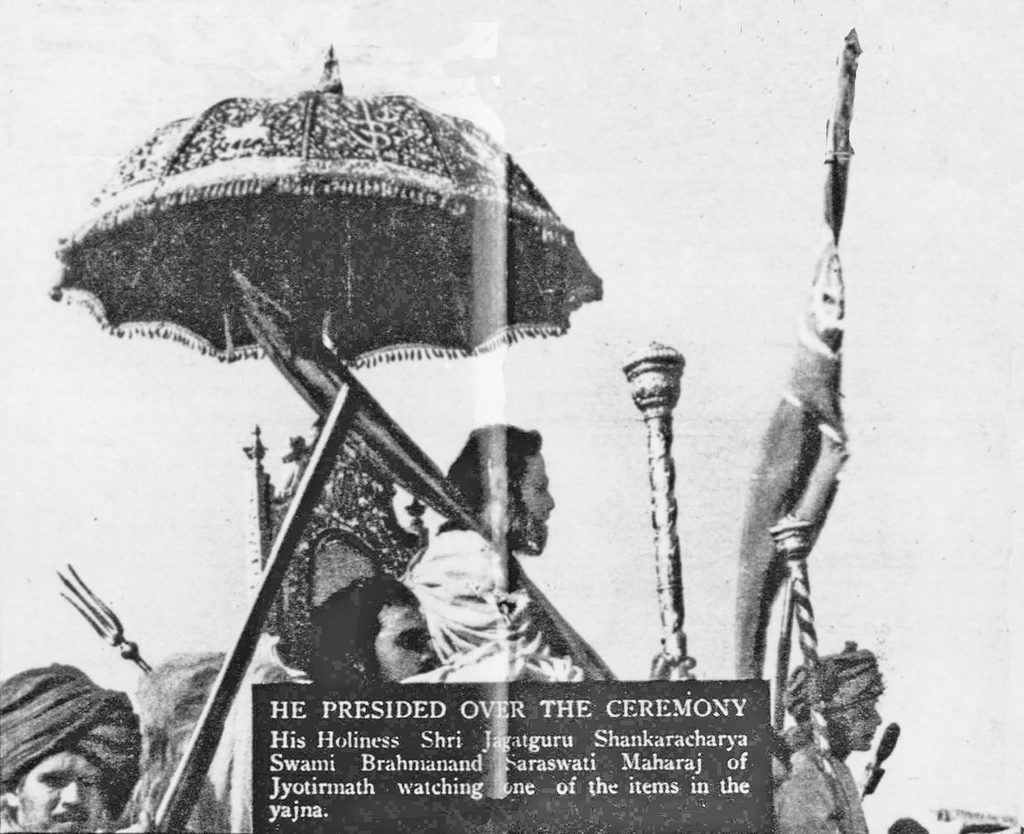
The gathering served as a historic convergence of India’s highest spiritual authorities. The Mahayagya was presided over by the Shankaracharya of Jyotirmath, Swami Brahmananda Saraswati, flanked in rare harmony by his fellow heads of the cardinal monastic seats:
- Swami Yogeshwaranand Teerthaji (Govardhan Math, Puri)
- Swami Bharati Krishna Tirtha (Dwarka Math)
- Swami Chandrasekhara Bharati (Sringeri Sharada Peetham)
Each morning and afternoon, an awe-inspired assembly of roughly 200,000 devotees gathered beneath the Delhi sky, watching the rhythmic cadence of oblations and listening to the collective roar of a thousand voices calling for the cessation of global butchery.
When the final oblation was poured into the embers on February 9, 1944, the 1,500 pandits were led through the historic avenues of Old Delhi in a grand civic procession. The ceremony culminated on the riverbank, where an estimated 500,000 people took a sacred dip in the Yamuna, cleansing themselves in the waters that had mirrored eleven days of ceaseless prayer.
In the archives of the Second World War, history books rightly record the movements of armies, diplomatic treaties, and industrial wartime production. Yet on the plains of Delhi in 1944, a radically different kind of warfare was waged: an audacious attempt to extinguish the fires of planetary hatred using the consecrated flames of peace.
Research materials and contemporary press reports sourced from The Times of India, Life Magazine, The Illustrated Weekly of India, Amrita Bazar Patrika, The Civil & Military Gazette, and The Delhi Archives, alongside the personal accounts and memoirs of Alain Daniélou, Major F. Yeats-Brown, and Swami Akhandananda Saraswati.
Special acknowledgements and grateful thanks to associate researchers Jeff Evans and Tony Evenson for their tireless work in uncovering invaluable archival news cuttings.