Indian Politics
The Timing of the Vadodara Plot Allotment and Questions of Political Incentive
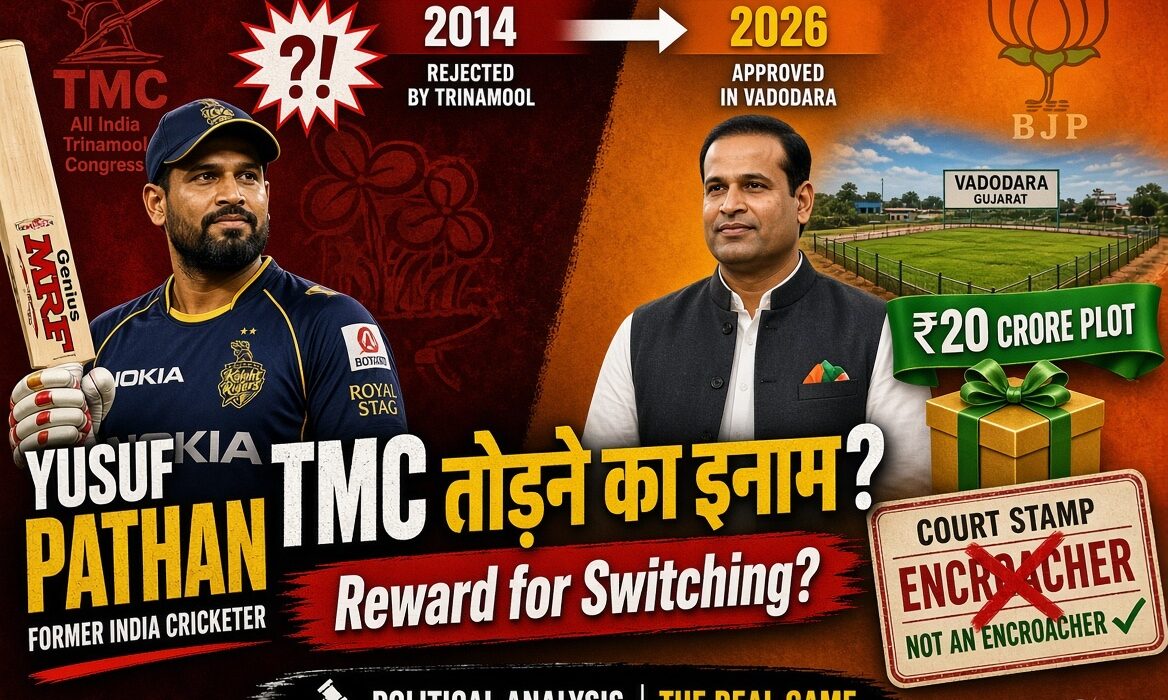
“TMC को तोड़ने का इनाम यूसुफ पठान को? बीजेपी की बेईमान राजनीति!” frames the Gujarat government’s October 2026 approval of a long-disputed 978-square-metre plot in Vadodara’s Tandalja area for former cricketer and Lok Sabha MP Yusuf Pathan as a political reward for his role in the post-election fracturing of the Trinamool Congress (TMC). The claim rests on a clear sequence of events rather than a documented “deal,” and that sequence is what makes the episode analytically significant.
The Political Sequence
Pathan won the Baharampur (Behrampur) seat in West Bengal in the 2024 Lok Sabha elections on a TMC ticket. After the BJP’s victory in the 2026 West Bengal Assembly elections, he was among roughly 20 TMC Lok Sabha MPs who broke from Mamata Banerjee’s leadership. They merged into or aligned with the Nationalist Citizens Party of India (NCPI) and positioned themselves to support the NDA in Parliament. Pathan was made a national vice-president of NCPI. Some of the rebel MPs, particularly the Muslim MPs from Murshidabad-area seats including Pathan, publicly distanced themselves from formally joining the BJP or attending NDA meetings, citing constituency sensitivities, while the broader group’s parliamentary support for the NDA was widely reported.
Within months of that realignment, the long-stalled land matter moved. Pathan withdrew his Gujarat High Court appeal on 31 August 2026. By mid-to-late October 2026 the state government had approved allotment: 500 sq m as a free residential “gift” and the remaining 478 sq m at 55% of the assessed valuation (a 45% concession). The plot’s market value was placed at approximately ₹20.53 crore (₹2.10 lakh per sq m). The resolution stated that the arrangement would not set a precedent and that the Revenue Department would compensate the Vadodara Municipal Corporation (VMC) with land of equivalent value. Final clearance still required the VMC Standing Committee and General Board.
The Legal and Administrative History
The dispute began in 2012 when Pathan sought a 99-year lease of the municipal plot adjoining his family home, citing security concerns linked to his international cricket profile. The VMC Standing Committee and General Board approved a direct (non-auction) allotment at then-prevailing rates, but the state Urban Development Department rejected it in 2014 on the ground that valuable land required public auction. The civic body later alleged that Pathan fenced and occupied the plot anyway.
After Pathan became an MP in 2024, the VMC issued an encroachment notice. He challenged it. A single-judge bench of the Gujarat High Court in August 2025 upheld the earlier rejection and effectively treated him as an encroacher, noting the absence of a completed allotment and payment. A Division Bench hearing the appeal was critical of continued possession of public land without formalities or payment and granted time to pursue a claim under a 1999 state policy for allotment of land to international cricketers. Pathan’s counsel later told the court that the civic body had not responded to representations under that policy, and the appeal was withdrawn unconditionally in late August 2026. The single-judge finding that he was an encroacher therefore remained on record at the time of the government’s subsequent approval.
Reading the Timing
The administrative case for the October decision is that a long-pending request under a sports-person policy was finally resolved, the court process had ended by withdrawal, and safeguards (no-precedent clause, compensatory land for VMC) were included. Pathan’s side had repeatedly invoked the 1999 policy and the fact that the VMC had once approved the proposal.
The political critique, which the video advances, treats the timing as the decisive fact. An issue that had been rejected by the state in 2014, pursued through litigation that produced adverse judicial observations, and met with an encroachment notice after Pathan entered Parliament on a TMC ticket, was resolved favourably within roughly four months of his exit from TMC and alignment with the NDA via NCPI. The free allotment of half the land (roughly ₹10.5 crore in value) plus a substantial concession on the rest is a material benefit. Correlation is not proof of a quid pro quo, and no public document or admission establishes an explicit bargain. Yet the sequence is difficult to treat as coincidental in a system where party switches by legislators are routinely accompanied by allegations of inducements, and where control of state machinery creates opportunities to deliver tangible benefits.
Broader Implications
Indian politics has long featured such patterns: rebel legislators or newly aligned leaders receive administrative or developmental relief that had previously been unavailable. The anti-defection law is intended to raise the cost of individual switches, but group realignments (especially when framed through a smaller party or external support) often dilute that deterrent. When the benefit involves public land previously subject to court scrutiny and allegations of encroachment, the episode also raises questions about the consistent application of rules governing public property. The explicit “will not set a precedent” language in the resolution acknowledges the exceptional nature of the decision while simultaneously highlighting that exceptionality.
Critics of the BJP see the episode as evidence that rules on public land, encroachment, and auction requirements can be relaxed when political alignment changes. Supporters of the decision, or those focused on Pathan’s long-standing claim, can argue that a 14-year dispute was simply closed under an existing sports policy once litigation ended, and that Pathan had been willing to pay for the land in earlier stages. Both readings are available; the strength of the “reward” interpretation derives mainly from the compressed timeline after the TMC split rather than from any single document that names a political motive.
The video’s framing—“reward for breaking TMC” and “BJP’s dishonest politics”—is therefore a political judgment about that timeline and about the incentives it creates for other legislators. The underlying facts (the split, the court record of encroachment findings, the withdrawal of the appeal, and the terms of the October allotment) are publicly documented across multiple reports. Whether the sequence demonstrates a direct transaction or merely the ordinary operation of political incentives in a high-stakes realignment remains a matter of interpretation. What is not seriously in dispute is that the resolution of the Vadodara plot arrived when Pathan’s parliamentary position had shifted, and that this coincidence is what fuels the charge of transactional politics.
