📰
Technology & AI
Stop Waiting for Phones to Get Cheaper. They Won’t Festive Sale Is a Trap This Year
SNAPSHOT: THE EARTHQUAKE IN ONE SCREEN
India did not lose interest in phones. It lost the ability to buy new ones at the prices that built the market. An AI-driven diversion of memory wafers toward High-Bandwidth Memory has quadrupled (and in some quotes, octupled) the cost of the RAM and storage that sit inside every smartphone. Because 60% of India still lived under Rs 20,000, the shock hit here harder than in China.
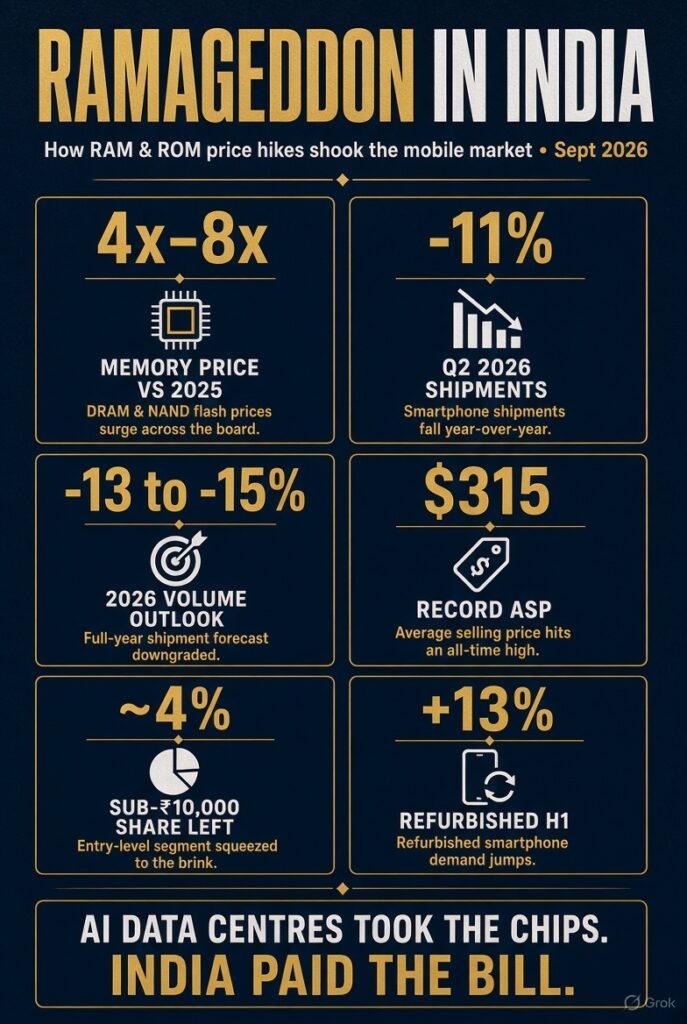
Key figures
Phone memory price vs early / mid-2025:
about 4x to 8x
India shipments, Q2 2026 YoY: -10% to -11%
Full-year 2026 volume forecasts: -13% to -15%
Record ASP in Q2 2026 (IDC): $315
Sub-Rs 10,000 share left: about 4%, down from about 19%
Refurbished volumes, H1 2026: +13%
PAST — THE CHEAP-MEMORY DECADE THAT BUILT MASS INDIA
India’s smartphone story from roughly 2014 to 2024 was a volume machine. Jio crashed data prices. Chinese brands crashed hardware prices. Memory cycles after 2016, 2018–19 and 2022–23 made RAM and NAND cheap enough that brands could keep adding gigabytes while cutting rupees. 2GB/16GB became 3GB/32GB became 4GB/64GB became 6GB/128GB — often without the customer noticing the component that made it possible.
How big the market became
2023: about 150–153 million. Post-COVID normalisation; 5G mix rising.
2024: 151 million (IDC) / about 153 million (Counterpoint). +1% to +4%; ASP $259; about 120 million 5G phones; 54 million feature phones still shipped.
2025: 152 million (IDC, +0.5%). Fourth flat year around 152 million; ASP $282; Apple record 14 million; phones above Rs 30,000 hit 23% share.
2026 outlook: about 128–132 million. First sharp contraction of the decade, driven by memory — not by lack of desire to own a phone.
About 60% of 2025 shipments sat under Rs 20,000. Sub-Rs 10,000 was still 16–19% of the market as late as mid-to-late 2025. Memory was 15–20% of BoM in those bands. India assembled phones under PLI but imported almost every DRAM and NAND chip, so the market was levered to global memory prices.
Techarc’s index of 79 models drifted to 92.2 by September 2025 — phones trading about 8% below launch. Contract memory turned in Q4 2025. By May 2026 the same index was 106.6. Prices fell slowly and rose sharply.
Timeline
2016–2019: Memory glut; India volume explosion under Jio + Chinese OEMs.
2020–2022: COVID spike then hangover; India still adds 5G at the bottom.
2023–2024: Plateau about 150–153 million; Apple crosses 12 million in 2024.
H1–Q3 2025: Last discount season. Index bottoms at 92.2.
Q4 2025: AI HBM pull bites LPDDR and NAND allocations.
2026 YTD: Multiple list-price hikes. Q2 shipments -10/-11%. Sub-Rs 10,000 share toward 4%. ASP $315.
WHY RAM AND ROM EXPLODED
RAM in a phone is LPDDR DRAM. ROM, in consumer language, is NAND flash behind UFS. Samsung, SK Hynix and Micron dominate DRAM; those three plus Kioxia/WD dominate NAND.
The 2025–26 shock is a capacity heist. AI accelerators need HBM, which can earn 5–6x the margin of commodity LPDDR. One HBM unit can displace about three units of conventional DDR capacity. What remains for phones is leftover LPDDR4X and LPDDR5/5X, plus UFS NAND competing with enterprise SSDs.
DRAM bit supply growth in 2026 is only around the mid-teens percent. New fabs largely contribute from 2027 onward.
Chip costs
8GB + 256GB combo (Omdia): about $35 in Q3 2025 → about $140 by Q3 2026e
12GB + 512GB combo: about $60 in Q3 2025 → about $202 by Q3 2026e
LPDDR5 96Gb (TechInsights): about $140 in June 2026 → about $165 at Sept 2026 launch → about $183 by March 2027e
256GB TLC UFS NAND: about $68 in June 2026 → about $82 at launch → about $92 by March 2027e
RAM+ROM in a Rs 40,000 phone: about Rs 2,000 in mid-2025 → more than Rs 12,000 in mid-2026
Memory share of budget BoM: under 20% → 45%+, approaching 60% in the cheapest SKUs
Quote: “In some cases, the cost of high-end memory today exceeds what the entire cost of a smartphone should be to be able to launch below Rs 25,000… a segment that was over 60% of the market in 2025.” — Akis Evangelidis, Nothing, June 2026
That is why successors get delayed, why 12GB models become 8GB, and why 16GB retreats to the extreme top of the list.
PRESENT — THE EARTHQUAKE INSIDE THE INDIAN MARKET
Q2 2026 reads like a break, not a pause. Counterpoint: -10% YoY, worst June quarter in six years. IDC: -11.1% to 33.2 million units. China fell only about 2%. India was hit because the mass market is the market.
The disappearing floor
Sub-Rs 10,000: share from about 16–19% in 2025 to about 4–4.5%; shipments -60% to -74%. Near wipeout.
Sub-Rs 15,000: shipments about -45% in Q2. Memory over 45% of BoM.
Rs 10,000–20,000: about 47% to about 46%. Looks stable only because dead Rs 8k models were re-priced into it.
Rs 20,000–30,000: share up to about 25%. The new mass market.
Rs 30,000–45,000: about 6% to about 10%. Compulsory step-up + financing.
Premium / luxe: some Techarc models -7% to -9% vs launch.
Techarc’s 79-model study found industry average prices +5.6%, but entry +17.6%, base +15.2%, premium pro and luxe down 7–9%. Examples: iQOO Z10 Lite 5G from Rs 9,999 to Rs 13,999 (+40%); Galaxy M16 5G from Rs 11,499 to Rs 15,999 (+39%).
By end of Q2, average handset prices were about 15% higher than at the start of 2026. Model-level moves ranged from 4% to 68%. IDC’s Q2 ASP of $315 (+14.4% YoY) is a record.
BRAND SCOREBOARD
Sample list-price revisions in 2026:
Samsung Galaxy A17 5G 8+256: Rs 23,499 → 26,499 (+3,000)
Samsung Galaxy M36 8+256: Rs 24,499 → 25,999 (+1,500)
Samsung Galaxy S26 base 12+256: Rs 87,999 → about 1,07,999 and further revisions (+12,000 to +20,000+)
OnePlus 15 12+256: Rs 72,999 → 77,999 (+5,000)
OnePlus 15R 12+256: Rs 47,999 → 54,999 (+7,000)
Nothing Phone (4a) Pro 8+128: Rs 39,999 → 44,999 (+5,000)
Nothing Phone (4a) 8+128: Rs 31,999 → 34,999 (+3,000)
Vivo Y400 8+256: Rs 21,999 → 28,999 (+7,000)
Vivo V70 8+256: Rs 45,999 → 49,999 (+4,000)
Realme 16 Pro+ 12+256: Rs 39,999 → 46,999 (+7,000)
Realme 16 Pro 8+256: Rs 33,999 → 39,999 (+6,000)
iQOO Neo 10: Rs 31,999 → 41,999 (+10,000)
Redmi Note 15 Pro / Pro+: +2,000
Samsung is the relative Android winner (scale, full ladder, sister memory division; mobile memory costs reported up about 211% in H1). Apple shipped a record about 14 million iPhones in India in 2025, with about 29% value share; 2026 units seen flat to slightly down. Vivo often kept unit leadership, but Y/T volume is under pressure. Xiaomi, Realme, Oppo, iQOO and Poco are cutting SKUs and raising prices; one IDC read had iQOO -61%. Nothing can grow from a small mid-premium base but cannot print a CMF successor that no longer maths.
HOW INDIAN BUYERS ARE REWRITING THE SCRIPT
Demand did not vanish. It changed vehicle.
Wait. Replacement cycles heading from 3–4 years toward 4–5.
Finance. EMI is how the new Rs 20,000–30,000 “mass” phone gets sold. Offline retail 62% in Q1 2026, up from 58%.
Buy used. Refurbished volumes +13% in H1 2026 while new devices -11%. Full-year refurbished outlook +16%. Organised players handle only about 20% of the secondary market. Samsung about 30% of refurbished share, Apple about 23%, Vivo about 10%. Organised refurbished premium estimated about $2.2 billion now, path toward about $7.8 billion by FY30.
Repair. In some global quarterly reads, display panels to the refurbish channel exceeded panels to new-phone makers.
Stay on 4G / feature phones longer. India shipped 54 million feature phones in 2024 (-11%). The gap between a feature phone and an entry smartphone is widening again.
Why India hurt more than China: about 60% of India under Rs 20,000 versus a richer China mix. India Q2 -10%; China about -2%.
FUTURE — 2027 TO 2030 IN THREE SCENARIOS
Base case: conventional DRAM tight through end-2027 and into 2028. NAND may balance earlier, in H2 2027. Take-or-pay floors run toward 2030.
Base — expensive normal: prices stop exploding but do not return to 2024. Units perhaps 130–145 million. Rs 20k–40k is the volume heart.
Bear — long supercycle: AI capex stays violent; another year of unit decline; rural first-time users delayed.
Bull — AI air-pocket: a sharp AI capex pause frees LPDDR/NAND in 2027; prices ease 15–25% off the peak, not back to 2024; units recover toward 145–155 million by 2028–29.
Even if memory softens after H2 2027, new retail floors in Rs 8,000–18,000 are likely to hold. ICEA: FY27 volumes -5% to -7%, industry value still +8% to +10%.
WHAT THIS DOES TO INDIA’S INDUSTRIAL BET
India is the world’s second-largest smartphone manufacturer by volume. Output climbed from about 290 million units in FY19 toward 380 million+ in FY24, value crossing Rs 2.85 lakh crore. PLI worked for assembly. It did not create a DRAM or NAND industry. As memory’s share of BoM rises from about 20% toward 40%+, more of every “Made in India” phone is imported silicon.
A credible new 5G Android device has migrated from the Rs 7,000–9,000 zone toward Rs 12,000–15,000. Digital-inclusion policy assumed a falling real price of the device. That assumption is broken for this cycle.
VERDICT
The past was a decade in which India could mint 150 million smartphones a year on a Rs 10,000–15,000 spine. The present is a V-curve that reversed the wrong way: Q2 2026 -10/-11%, ASP $315, sub-Rs 10,000 share at about 4%, refurbished +13% while new phones shrink. The future is two to four years of expensive memory, a smaller unit market, a richer mix, heavier EMIs, and a used-phone buffer.
The mechanism is global. The damage map is local — because India was the large economy most leveraged to cheap DRAM and NAND. Memory is no longer an invisible component. It is the price of the phone.